Picture this: the front desk phone won’t stop ringing. Meanwhile, the billing team is buried under denied claims. At the same time, a nurse just spent twenty minutes on hold with an insurance company instead of seeing patients. Sound familiar?
This is daily life for thousands of US healthcare providers right now. And it’s exactly why healthcare BPO services have become one of the smartest moves a practice can make in 2026.
You hand off the paperwork-heavy, repetitive tasks to trained specialists, and your team gets its time back for actual patient care. Let’s break down what these services really are, why they’re exploding right now, and how you pick a partner worth trusting.
What Are Healthcare BPO Services?
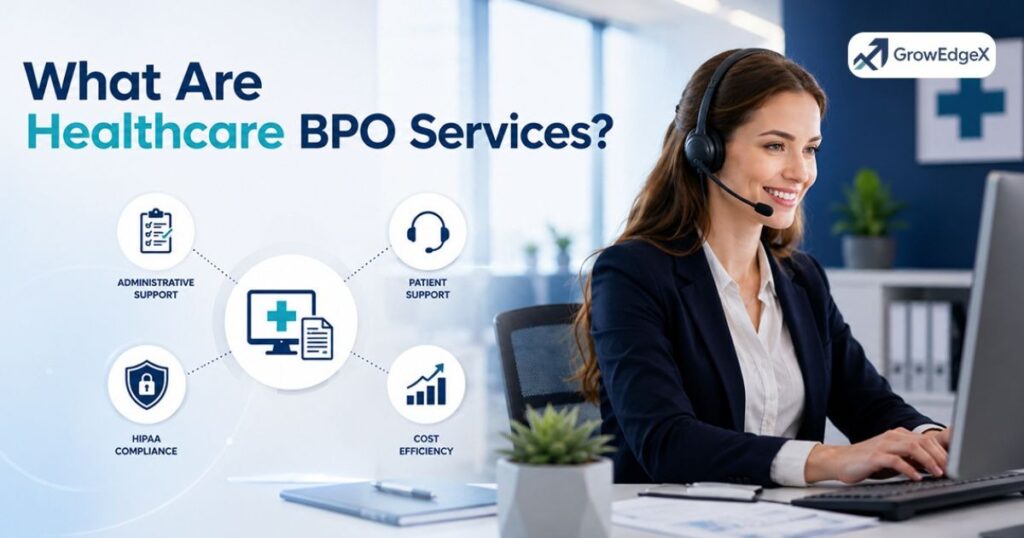
Simply put, healthcare BPO services mean outsourcing the non-clinical side of your practice to a specialized outside company. Billing, coding, scheduling, claims, data entry. All of it can move off your plate.
Think of a busy family clinic in Plano. Two front-desk staff members are drowning in insurance calls, and the phone rings nonstop during lunch. That’s the exact gap business process outsourcing was built to close. A healthcare outsourcing partner steps in, trained on your systems, and the phone gets answered every single time. Your staff gets their afternoon back. Patients get faster answers. Nobody has to choose between the two.
Why Everyone’s Talking About Healthcare Outsourcing Right Now
Here’s what’s really going on. Providers didn’t start outsourcing because it sounded trendy. They started because the old way stopped making sense.
Margins keep getting tighter every year. Staffing costs keep climbing, and payroll now eats up a huge chunk of most practices’ budgets. On top of that, insurance denials keep rising too. More claims are getting rejected than ever before, and every denied claim means delayed payments, extra staff hours, and more stress on your team.
This is where healthcare BPO services step in. Handing off billing and claims work to trained specialists means fewer denials, faster payments, and a lot less pressure on your in-house staff.
The Numbers at a Glance
| Metric | Figure | Source |
| US healthcare BPO market size, 2026 | Roughly $167.3 billion | MarketDataForecast |
| Fastest-growing segment, 2026-2031 | Provider Services, 12.73% CAGR | Mordor Intelligence |
| Providers with denial rates above 5% | Nearly 20% | HFMA/Guidehouse via Prolink |
| Median hospital operating margin, late 2025 | 1.3% | Kaufman Hall via Prolink |
Healthcare BPO Services: What Can You Actually Outsource?
Almost every back-office function in a healthcare practice can move to a BPO partner. The real question is what makes sense for your size and specialty.
| Category | What It Covers |
| Revenue cycle management | Billing, coding, claims submission, accounts receivable follow-up |
| Patient support | Scheduling, call center services, virtual receptionists, after-hours answering |
| Clinical documentation | Medical transcription, EHR data entry and updates |
| Compliance and credentialing | HIPAA audits, provider credentialing, prior authorization support |
| HR and payroll | Recruiting, onboarding, benefits, payroll processing |
| IT and infrastructure | EHR maintenance, network monitoring, cybersecurity, equipment planning |
Here are some more key services discussed below:
Medical Billing and Coding
Medical billing and coding demand precision most in-house teams struggle to maintain. A trained healthcare BPO team handles ICD, CPT, and HCPCS codes daily, which means fewer claim rejections and faster reimbursements for your practice.
Claims Processing and Denial Management
Denied claims cost time and money. Outsourced claims processing teams track every submission, follow up with insurers, and appeal denials before they slip through the cracks, keeping your revenue cycle moving.
Patient Scheduling and Intake
Missed calls mean missed patients. A dedicated healthcare outsourcing partner manages appointment booking, reminders, and intake forms, so your front desk never falls behind during busy hours.
Data Entry and Records Management
Patient files, lab results, and prescriptions all require careful handling. Medical BPO teams manage this data with strict accuracy standards, reducing errors that can delay care or billing.
HR and Payroll Support
Staff onboarding, benefits, and payroll compliance take real bandwidth. Outsourcing these functions to a healthcare BPO partner keeps your practice compliant without pulling management away from patient-focused priorities.
The Real Benefits You’ll Notice

Cost savings get all the attention, but that’s really just the entry point. The bigger win is access to people who already know payer rules and coding updates cold. You don’t train them. They arrive ready.
Scalability matters just as much. Patient volume shifts throughout the year, and hiring full-time staff for every busy season rarely makes sense. A good BPO partner scales your support up or down within days.
Solvo Global reports that practices using offshore or nearshore staffing can save up to 60% annually compared to hiring an equivalent US-based employee. Many practices pour those savings straight back into patient care and better equipment.
There’s also a talent angle worth mentioning. Hiring locally limits you to your immediate area’s job market. Outsourcing opens the door to a much bigger pool of trained, specialized professionals, which matters a lot in fields facing serious staffing shortages.
Onshore, Nearshore, or Offshore: What Fits Your Practice?
The delivery model you pick shapes your costs, your communication speed, and how closely your outsourced team can work alongside yours.
| Model | Savings Potential | Time Zone Fit | Best For |
| Onshore | Low to moderate | Excellent | Sensitive clinical support, complex compliance work |
| Nearshore | Moderate to high | Strong | Real-time collaboration, RCM, patient support |
| Offshore | Highest | Limited overlap | High-volume back-office tasks, transcription, data entry |
Explore More: Business Process Outsourcing Services across USA 2026
Choosing a Healthcare BPO Partner You Can Trust
Don’t rush this decision. A weak vendor can slow your revenue cycle down instead of speeding it up, or worse, put patient data at risk.
Start with compliance. HIPAA adherence isn’t optional, and certifications like SOC 2 are strong signals that a vendor takes security seriously. Fines for HIPAA violations can reach $50,000 per incident, so this isn’t a corner worth cutting.
English communication skills matter too, especially for patient-facing roles. Look for partners who invest in accent training and measure telephone communication quality, not just typing speed.
| What to Check | Why It Matters |
| HIPAA and SOC 2 compliance | Protects patient data and avoids legal penalties |
| Healthcare-specific experience | Cuts onboarding time and reduces coding errors |
| EHR and software compatibility | Prevents workflow disruptions |
| Transparent pricing | Avoids hidden fees later on |
| Dedicated account manager | Faster issue resolution and clear accountability |
Ask for references. Talk to their current clients. A vendor confident in their work will hand these over without hesitation.
Where AI Fits Into the Picture

AI isn’t replacing the human side of healthcare BPO. It’s making that human side sharper. Automation now catches coding errors before submission and flags claims likely to get denied, saving your team from chasing problems after the fact.
Chatbots and virtual assistants handle basic scheduling and insurance questions around the clock. Human agents step in for the complex stuff. Patients get faster answers, and your staff gets more room to focus on conversations that actually need a human touch.
Common Concerns and How to Handle Them
Let’s be honest about the downsides too, because pretending they don’t exist helps nobody.
Data security tops most providers’ worry list, and that concern is fair. Sharing patient information with an outside team always carries some risk. Reputable partners handle this through encryption, strict access controls, and regular compliance audits, not just a promise in a sales pitch.
Communication gaps can also creep in, especially across time zones. The fix is simple. Insist on a dedicated account manager, weekly reporting, and a clear escalation path before you sign anything.
There’s also the question of control. Once a task moves outside your building, you’re trusting someone else to do it your way. That’s why vetting a partner thoroughly before signing matters more than chasing the lowest price on the table.
Healthcare BPO in Plano, Texas and the DFW Market
Texas providers face a specific mix of pressures: a fast-growing population, a competitive hiring market, and increasingly complex payer requirements. Clinics and practices across Plano, Dallas, and Fort Worth are turning to healthcare BPO services specifically because local hiring has gotten harder and costlier every year.
A regional BPO partner familiar with Texas regulations and DFW’s provider networks brings something a distant, generic vendor can’t always match: local context. That means faster onboarding, fewer communication gaps, and a partner who already understands the payer landscape most common across North Texas practices.
GrowEdgeX: A Trusted Healthcare BPO Partner in Plano, TX

GrowEdgeX, based in Plano, Texas, works with healthcare providers across the Dallas-Fort Worth area. That includes HIPAA-compliant medical billing, patient intake coordination, and payroll services, all handled by a dedicated team trained specifically on your practice’s workflow.
Every engagement starts with clear service level agreements and measurable performance metrics, so accountability never gets lost in translation.
For clinics and hospital networks across Plano, Dallas, Fort Worth, Frisco, McKinney, and Allen, that local understanding often makes the difference between a smooth outsourcing partnership and one that creates more friction than it resolves.
If you’re exploring healthcare BPO services for your own practice, GrowEdgeX offers a free consultation to walk through your specific needs.
FAQ’s
What do healthcare BPO services actually cover?
They cover non-clinical administrative work: medical billing, claims processing, scheduling, data entry, transcription, and HR functions. Clinical care and diagnosis always stay with your in-house medical staff.
Is outsourcing healthcare billing HIPAA compliant?
It can be, provided the BPO partner maintains proper HIPAA training, encryption standards, and access controls. Always verify compliance certifications before signing a contract.
How much does healthcare BPO typically save a practice?
Savings vary by practice size and scope, but most providers report meaningful reductions in administrative overhead compared to building an equivalent in-house team from scratch.
Can small clinics use healthcare BPO services, or is it only for hospitals?
Small clinics use these services just as often as large hospital networks. Many BPO partners offer modular services so that a practice can outsource only billing, only scheduling, or a broader combination.
How much can a practice actually save?
Savings vary by scope and size, but many practices report cutting labor and admin costs by up to 60% compared to hiring in-house staff for the same work.
Final Thoughts
Healthcare BPO services give US providers a real way to cut costs, shrink claim denials, and free up time for actual patient care. From billing and scheduling to compliance and IT support, outsourcing lets you tap into specialized expertise without building an entire department from scratch.
As margins stay tight and patients expect faster, smoother service, the practices that outsource wisely tend to pull ahead of the ones trying to juggle everything alone. Pick your partner carefully, and the payoff shows up fast, in your cash flow and in your patients’ experience.