Every business wants happy customers. But building and running a full in-house support team is expensive, slow, and hard to scale. That’s exactly why customer service BPO has become one of the smartest moves companies make today.
From startups to Fortune 500 firms, thousands of U.S. businesses now rely on BPO support to handle everything from phone calls to live chat and email. This guide breaks it all down: what customer service BPO really means, how it works day to day, what you gain, what you risk, and how to pick the right partner to drive real growth.
What is Customer Service in BPO?
Customer service BPO, or Business Process Outsourcing, means hiring a third-party company to handle your customer support operations. Instead of building your own team from scratch, you hand that work to specialists who do it every day.
These BPO service providers bring trained support agents, proven systems, and the technology to deliver consistent, high-quality service delivery at scale.
Think of it this way. You run a growing e-commerce brand. You can’t afford to hire 40 support reps, train them, buy the software, and manage the whole team.
A customer service BPO does all of that for you, usually faster and at a lower cost. It’s not just about cutting costs, though. It’s about getting better at serving customers without losing focus on your core business.
| BPO Function | What It Covers |
| Inbound Support | Phone, email, live chat, and social media queries |
| Outbound Support | Follow-ups, surveys, and proactive customer calls |
| Technical Help Desk | Troubleshooting, product guidance, and escalation |
| Back Office Tasks | Data entry, order processing, and billing support |
What is Good Customer Service in BPO?
Good BPO support goes beyond just answering calls fast. It means resolving issues on the first contact, speaking with empathy, and leaving customers feeling valued.
A quality help desk team tracks satisfaction metrics, reviews call recordings, and adjusts its approach based on real data. Customer delight isn’t accidental; it comes from consistent training, smart tools, and a culture of accountability.
Is Customer Service Associate a BPO Job?
Yes, absolutely. A customer service associate at a BPO is a frontline support rep who handles customer inquiries on behalf of a client company. They might work in a physical call center or remotely. Their job covers answering inquiries, processing requests, and escalating complex issues. It’s one of the most common entry-level roles in the business outsourcing world.
Difference Between BPO and Customer Support
| Aspect | Customer Support | BPO (Business Process Outsourcing) |
| Definition | A function focused on helping customers resolve issues and queries | A business model where processes (like support) are outsourced to third-party providers |
| Nature | Operational activity | Delivery model/outsourcing strategy |
| Purpose | To assist and support customers | To handle business functions efficiently at scale |
| Execution | Can be done in-house or outsourced | Always involves a third-party external provider |
| Scope | Limited to customer interactions | Covers multiple processes (customer support, back office, IT, etc.) |
| Flexibility | Can be internal or external | Specifically external (outsourced) |
| Example | A company handling its own support team | A company outsourcing support to a BPO provider like Growedgex |
Explore More: What Is Business Process Outsourcing (BPO)? 2026 Guide
Benefits of Working with a Customer Service BPO
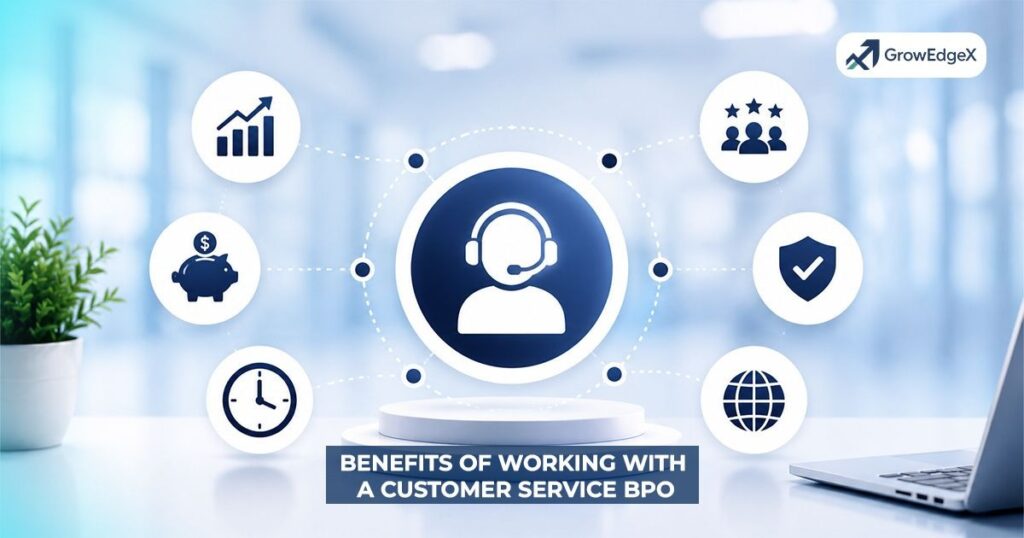
Partnering with a customer service BPO delivers advantages that go well beyond saving money. Companies gain access to expertise, flexibility, and infrastructure that would take years to build internally. Client engagements become more consistent. Response times drop. And your internal team can finally focus on growth rather than firefighting customer complaints.
The impact shows up in the numbers. According to a survey, 70% of companies outsource primarily to reduce costs, but 40% do it specifically to improve service quality. Both goals are achievable with the right partner.
Access Specialized Expertise
A BPO provider does customer service all day, every day. Their service staff is trained professionals who understand how to de-escalate difficult conversations, handle high call volumes, and maintain service quality under pressure.
You’re not hiring generalists. You’re plugging into a team that’s already mastered the craft. That specialized knowledge becomes your competitive advantage almost immediately.
Minimize Hiring and HR Challenges
Recruiting, onboarding, and retaining customer support staff is genuinely hard. Turnover in support roles averages 30-45% annually in the U.S. A BPO absorbs all of that pain.
They handle recruitment, training, performance management, and HR compliance. You skip the headaches and get a ready-to-go help desk team without the overhead.
Gain Staffing Flexibility
Seasonal spikes happen. Product launches drive a surge in contacts. Holidays create chaos. With an in-house team, scaling up takes months.
A customer service BPO can add capacity in days. This operational outsourcing model gives your business the ability to scale support up or down based on real demand — without long-term hiring commitments.
Reduce Operational Costs
Third-party support typically costs 40-60% less than building an equivalent in-house team. You eliminate salaries, benefits, office space, equipment, and software licensing.
You pay for the service you use. That freed-up budget goes back into product, marketing, or growth.
| Cost Category | In-House Team | BPO Partner |
| Salaries & Benefits | High | Included in contract |
| Office & Infrastructure | High | Covered by the provider |
| Training & Development | Ongoing | Handled by BPO |
| Software & Technology | Significant | Bundled or shared |
| Scalability | Slow & expensive | Fast & flexible |
Improve Customer Service Metrics
BPOs are accountable to numbers. They track first-call resolution rates, average handle time, CSAT scores, and satisfaction metrics with precision. That accountability drives continuous improvement. Your performance boost comes from having a team whose entire job is to hit service targets, not one team among dozens you’re trying to manage.
Increase Customer Retention and Loyalty
Happy customers stay. It’s that simple. When your BPO support team resolves issues quickly and treats customers with respect, client retention improves naturally. Studies show that increasing customer retention by just 5% can boost profits by 25-95%.
Loyalty building isn’t just a nice goal; it’s a revenue strategy. Repeat business from satisfied customers costs far less to generate than acquiring new ones.
Enhance Business Reputation
Word travels fast, especially online. A seamless service experience leads to positive reviews, referrals, and stronger brand loyalty. A single bad support interaction, on the other hand, can go viral.
Partnering with a capable BPO protects your brand’s industry standing and positions you as a company that genuinely cares about its customers.
Challenges in Customer Service Outsourcing
Even a well-chosen BPO partner comes with challenges. The key is knowing what they are, so you can plan for them. Most issues that arise in process outsourcing relationships come down to communication, culture, or data, three areas you absolutely cannot ignore.
Proactive businesses address these challenges during the contract negotiation phase. Don’t wait until a problem surfaces.
Communication Barriers
If your BPO team operates across time zones or in regions where English isn’t the primary language, communication gaps can surface. Call handlers may struggle with regional accents, slang, or complex product terminology.
The fix is rigorous training, clear scripts for common scenarios, and regular feedback loops between your team and the BPO’s management. Weekly calls and shared performance dashboards help close the gap significantly.
Cultural Differences
Client happiness depends partly on cultural understanding. A support interaction that feels perfectly polite in one culture might feel cold or abrupt in another. U.S. customers, for example, often expect warmth, small talk, and empathy alongside problem-solving.
If your BPO team isn’t trained on American communication norms, user experience can suffer. The best providers invest in cultural training as part of their onboarding; ask about it before you commit.
Data Security and Privacy Concerns
Your customers share sensitive information with your support team: account numbers, addresses, payment details, and personal data. When that data flows through a third-party support provider, security becomes critical.
Ask every potential BPO partner about their data encryption standards, access controls, employee vetting procedures, and compliance certifications. GDPR, CCPA, and SOC 2 compliance are good baseline requirements for any provider serving U.S. businesses.
Read More: Pros and cons of outsourcing for US business 2026
Why Choose Growedgex for Customer Service BPO?
Growedgex stands out as a reliable customer service BPO partner. It combines smart outsourcing with real business results. The team builds tailored customer support solutions based on your industry and goals. This works especially well for businesses targeting the U.S. market.
Trained agents handle omnichannel support across phone, chat, and email. This improves response time and customer satisfaction. It also helps streamline backend operations.
With 24/7 global coverage, your customers get support anytime. Flexible and cost-efficient pricing supports business growth. Growedgex is a strong choice for scalable, high-quality customer support outsourcing.
FAQ’s
What is the difference between BPO and customer service?
Customer service is the activity of helping customers with questions, issues, and needs. BPO is the delivery model of outsourcing that involves the activity being outsourced to a third-party provider. Customer service BPO combines both: it’s the practice of using an external partner to deliver your customer service function.
What is back office outsourcing?
Back office outsourcing refers to handing off non-customer-facing business functions to a third-party provider.
That includes data entry, order processing, payroll, billing, and compliance management. It’s the operational backbone that keeps a business running, handled externally so your team can focus on front-line growth.
Is outsourcing customer support worth it?
For most businesses, yes. Supporting outsourcing reduces costs, improves service quality, and allows faster scaling than in-house hiring.
The key is choosing a provider with the right experience, technology, and cultural alignment. Done well, it’s one of the highest-ROI decisions a growing business can make.
Conclusion
Customer service BPO is more than a cost-cutting move; it’s a strategic choice that shapes how customers experience your brand every single day. The right BPO partner brings expertise, technology, and flexibility that most businesses simply can’t build on their own. Yes, there are challenges to navigate: communication gaps, data security, and finding the right cultural fit.
But with careful partner selection and clear expectations, a customer service BPO delivers real competitive advantage. Whether you’re scaling fast or just trying to serve your customers better, outsourcing your support function could be the smartest step your business takes this year.