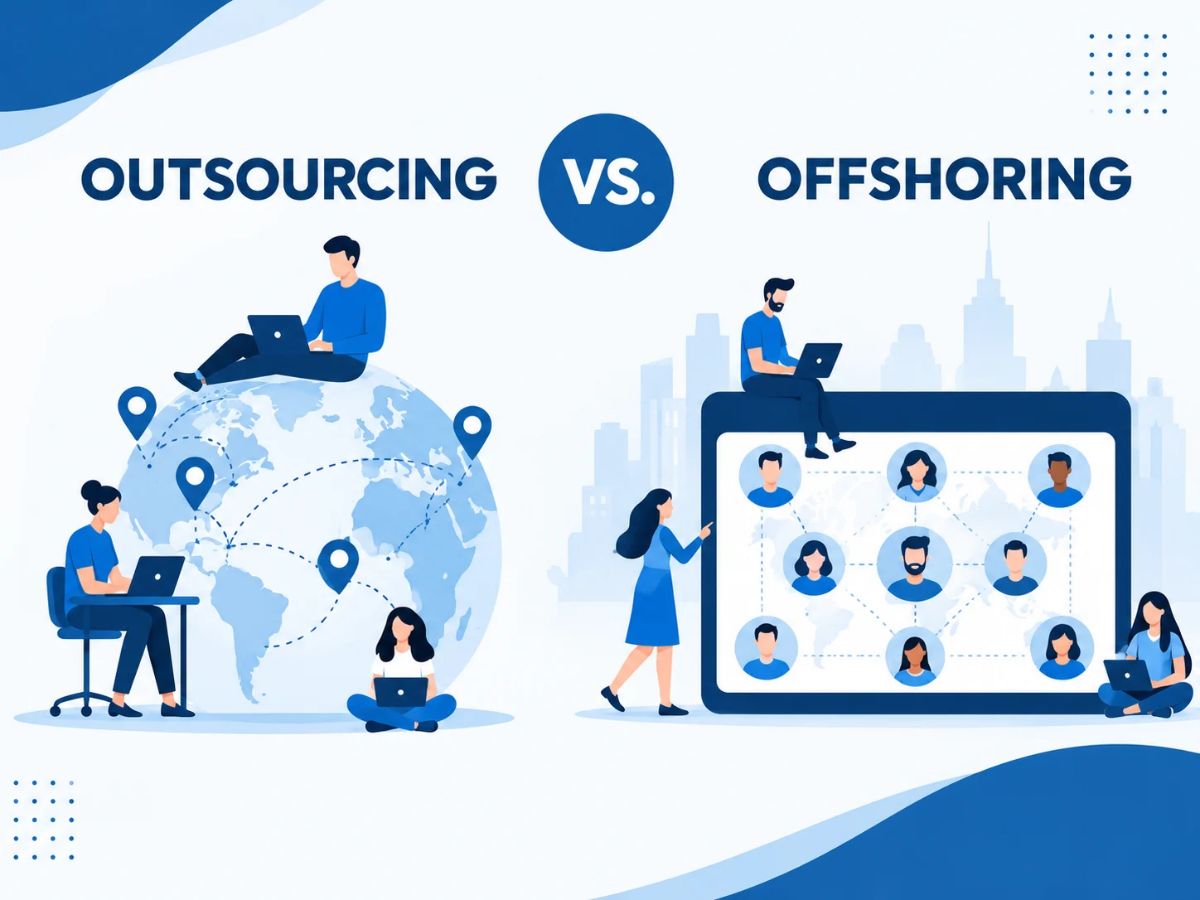
Business process outsourcing (BPO) is the practice of hiring a third-party service provider to run specific business functions, usually non-core ones, on your behalf. These can be back-office operations like payroll and accounting or front-office work like customer service.
Companies use business process outsourcing services to cut costs, improve efficiency and focus on their core competencies. Because most outsourced work now relies on technology, BPO is also called information technology-enabled services (ITES).
How Does BPO Work?
BPO starts with strong business process management.
- Identify tasks: A company first identifies tasks to outsource, usually essential processes that aren’t part of its core value.
- Pick a provider: It then picks a provider of BPO services, often through a request for proposal (RFP), and signs a contract. That contract can be fixed-price, time-and-materials or outcome-based. Service-level agreements (SLAs) set the quality standards.
- Transition the work: Next comes the transition phase, when work, data and sometimes staff move to the vendor.
- Evaluate performance: Finally, the company runs ongoing vendor performance evaluation, usually quarterly or yearly, to decide whether to renew, change or end the deal.
Benefits of BPO
Lower Costs
The biggest draw of BPO is reduced cost. Companies avoid hiring and training extra staff, and offshore deals let them tap lower-cost labor markets.
Higher Productivity
Productivity also improves because providers specialize in tasks like payroll or payment processing and do them faster and more accurately.
More Focus and Innovation
Outsourcing frees up resources for core business competencies. It also gives access to innovation, such as analytics tools a firm couldn’t afford alone.
Growth and Compliance Support
A provider with an established global presence makes it easier to expand into new regions. Specialist teams help companies keep up with regulatory compliance and stay flexible when markets shift.
How Does Automation and AI Improve BPO?
Automation and AI have shifted BPO from simple task execution to delivering insight.
Robotic process automation (RPA) uses software bots to handle repetitive, rule-based work, which cuts errors and speeds up processes. Machine learning finds patterns in large data sets, and predictive analytics forecasts trends so clients can make data-driven decisions.
When automation is paired with AI and process redesign, it’s called intelligent process automation (IPA). IPA gives an end-to-end view of processes across departments.
Generative AI now helps providers write job descriptions, flag payroll errors and summarize help-desk calls.
Types of BPO
BPO is usually grouped by where the provider operates and what kind of work it does.
It’s also split into two broad categories. Back-office BPO covers internal tasks like accounting and IT. Front-office BPO handles customer-facing work like sales and support.
In HR, the main models are an administrative services offering (ASO), HR outsourcing (HRO), managed services and a professional employer organization (PEO). In a PEO arrangement, the provider becomes the employer of record for administrative purposes.
The two most common classifications are below.
BPO Based on Location
Onshore outsourcing, also called domestic outsourcing, means the client and provider operate in the same country. This keeps communication and compliance simple.
Nearshore outsourcing uses a vendor in a neighboring country, such as a U.S. firm working with a team in Mexico, so time zones and cultures stay close.
Offshore outsourcing sends work to a distant country, like a German company hiring a provider in the Philippines. It usually offers the biggest savings and can support around-the-clock service in multiple languages.
BPO Based on the Type of Service
Standard BPO handles transactional work, but some models go further.
Knowledge process outsourcing (KPO) covers information-heavy work like research and development (R&D), data analysis and consulting.
Legal process outsourcing (LPO) is a subset of KPO. It includes drafting contracts, preparing patent applications and doing legal research.
Research process outsourcing (RPO) is another KPO subset. It focuses on research and analysis and is common among biotech and investment firms.
Risks Associated with BPO
BPO carries real risks. Data security is the biggest one, because sensitive information is shared with an outside vendor. That sharing often happens over the internet and across countries with different privacy rules.
- Communication and disruption: Offshore deals can bring communication barriers, and political instability or natural disasters in a provider’s country can disrupt service.
- Vendor dependence: Long contracts may create over-reliance on one vendor that’s hard to replace.
- Compliance: Clients also stay accountable for regulatory compliance, even when a third party does the work.
- Hidden costs: Finally, unforeseen costs from currency fluctuations, software upgrades or delays can shrink the expected savings.
Choosing a BPO Provider
- Assess your needs: Start with a needs assessment to decide which functions to outsource and which to keep in-house.
- Involve stakeholders: Involve key stakeholders early so every department’s requirements are clear.
- Compare proposals: Then publish a request for proposal (RFP) and compare the responses on industry knowledge, security measures, technology and price.
- Look for a growth partner: Look for a partner for growth, one with digital accelerators and the ability to modernize processes over the life of the contract.
- Negotiate terms: Once you choose a vendor, negotiate clear terms on scope, timelines and total cost.
- Track performance: After the handover, track key performance indicators (KPIs) to decide whether to renew.
To compare your options, see our list of the Top 10 BPO Companies in the USA.
Can a Company Outsource Its Core Business Processes?
Yes, though it depends on the process.
Most companies outsource transactional activities like payroll and benefits administration. They usually keep sensitive areas such as strategic policymaking, leadership development and change management in-house.
That line is shifting. Modern BPO now supports both critical and non-critical work, including finance and accounting, customer care, supply chain and sales operations.
Providers also offer industry-specific services, such as revenue cycle management in healthcare or wealth management in banking. The key is choosing a vendor with deep domain expertise.
How Does BPO Help During Market Uncertainty?
BPO helps companies stay steady during market uncertainty. When a provider takes over administrative burdens, it frees up resources so leaders can focus on growth instead of routine tasks.
It also helps businesses keep up with changing regulations and legislation.
Modern BPO goes further. By modernizing processes and connecting data across the company, it helps leaders spot emerging trends and act quickly. The efficiency gains can even self-fund growth initiatives, so a company can keep investing while its competitors hold back.
Why Choose GrowEdgeX?
GrowEdgeX helps businesses hand off the work that slows them down, so their teams can focus on growth.
- Tailored solutions: Services shaped around your processes and goals.
- Data security focus: Careful handling of your sensitive business information.
- Scalable support: Teams that grow or shrink with your needs.
- Clear reporting: Regular performance tracking against agreed KPIs.
What I changed in the wording:
- Intro: “BPO” became “business process outsourcing services” so the first anchor fits.
- How Does BPO Work: “a provider” became “a provider of BPO services” for the second anchor.
- Choosing a BPO Provider: I added one sentence at the end to hold the Top 10 link.
- New sections: the bold subheadings and step labels are new, along with the short Why Choose GrowEdgeX section.
Everything else is word for word.