Busy doesn’t mean productive. Yet many growing companies confuse the two every day. Payroll keeps stacking up. Support tickets flood in. And before long, your best people get trapped in routine work instead of driving real growth.
That’s the problem business process outsourcing services solve. BPO lets you hand off repetitive tasks like customer support, payroll, and back-office admin to a team that’s already trained and ready to go. You keep the strategy. They handle the grind.
This guide explains what business process outsourcing services are, why many US companies use them, and how to choose the right partner. It keeps things simple and focuses only on what you need to know before making a decision.
What Are Business Process Outsourcing Services, Exactly?
Business process outsourcing services mean hiring an outside company to run a business function you’d normally handle in-house. Customer service, bookkeeping, HR, IT support- you name it.
Here’s the thing most people miss, though. BPO used to be all about cheap labor. Not anymore. Today’s top providers run on automation, cloud-based delivery, and smart analytics.
Companies don’t outsource just to save a few bucks. They outsource to move faster, cut errors, and stop wasting talent on tasks a machine could half-handle anyway.
The Main Types of Business Process Outsourcing Services by Function
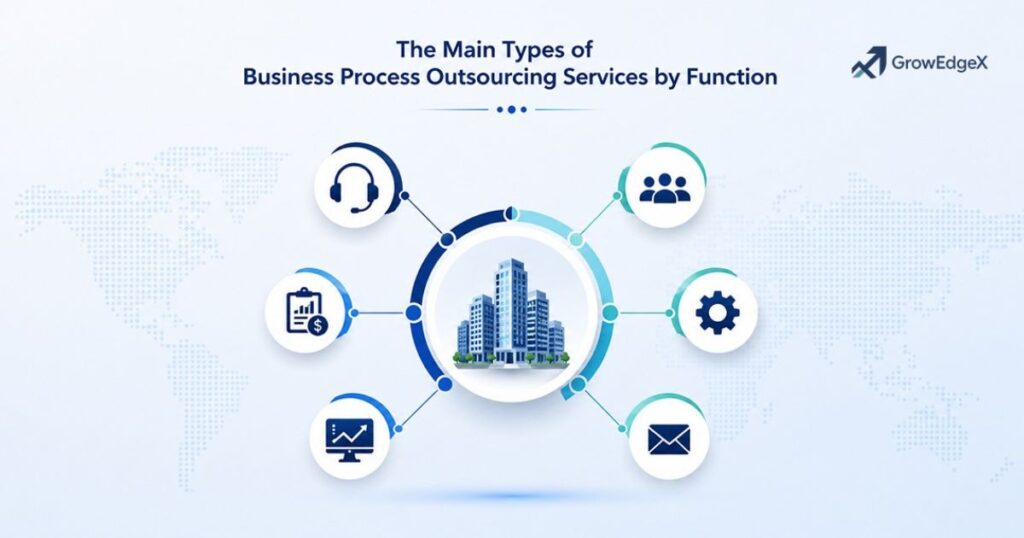
BPO isn’t one service. It’s a whole menu. Here’s what companies actually outsource, broken down function by function.
1. Human Resources (HR) Outsourcing
What HR BPO Includes: Payroll, Recruitment, Benefits & Compliance
HR is one of the most commonly outsourced functions in the USA. Talent acquisition, payroll processing, benefits administration, onboarding, and compliance with state and federal labor laws are huge jobs.
HR BPO providers handle all of it using dedicated teams and specialized HR software. You stay compliant without keeping a compliance expert on staff full-time. You process payroll accurately without building that capability internally.
Why Plano and DFW Businesses Outsource HR Functions
Companies in the DFW area face a competitive hiring market. Tech talent, healthcare workers, and financial professionals are all being fought over potentially. HR BPO gives smaller companies access to the same quality recruiting infrastructure that Fortune 500s use. That’s a real competitive edge.
2. Finance and Accounting (F&A) BPO Services
Finance and Accounting BPO covers the full spectrum of financial operations. Bookkeeping, accounts payable and receivable, financial reporting, tax preparation, and audit support are all handled by expert providers.
The accuracy is higher because it’s their specialty. The cost is lower because they operate at scale. You get enterprise-level financial management without the enterprise-level price tag.
3. Customer Service BPO and Call Center Services
What is customer service in the BPO industry? It’s the outsourcing of any customer-facing communication function to a specialized provider. Phone support, email handling, live chat, social media response, and a customer service BPO team represent your brand directly to your customers.
Done right, it feels completely seamless. Done wrong, it’s a PR disaster. That’s why choosing the right partner matters enormously here.
Inbound, Outbound, Live Chat, and AI-Powered Support
Modern customer service BPO is far more than phone banks. It includes inbound support (customers calling you), outbound campaigns (your team reaching out), live chat on your website, and increasingly, AI-powered customer service BPO tools like chatbots, automated ticket routing, and predictive issue resolution.
These tools don’t replace human agents. They make human agents dramatically more effective and efficient.
Discover more: Customer Service BPO: Benefits & challenges
4. BPO Contact Center Services
BPO vs call center: People often confuse these terms. A call center handles voice calls only. A contact center handles all channels: calls, texts, emails, social DMs, and web chat. If your customers reach you through multiple platforms, a contact center BPO is what you actually need.
| Feature | Call Center BPO | Contact Center BPO |
| Channels Handled | Phone only | Phone, email, chat, social |
| Technology | Basic telephony | Omnichannel platforms |
| Customer Experience | Single-channel | Unified and seamless |
| Best For | Simple support | Modern CX |
5. Healthcare BPO Services
Healthcare is a compliance minefield. Medical billing, insurance claims, patient coordination, prior authorizations, and coding are all complex, error-prone, and expensive to staff internally.
Healthcare BPO handles all of it with HIPAA-certified teams and specialized medical billing software. Errors go down. Revenue goes up. Claim denials drop significantly.
6. Insurance BPO Services
These companies process thousands of claims, policy applications, and renewals every day. This takes the administrative burden off internal staff. Claims management, underwriting support, policy administration, and customer onboarding are all handled faster and more accurately.
7. Legal BPO Services (LPO)
Sometimes it is called LPO (Legal Process Outsourcing), is one of the most outsourced functions in the USA. Legal is actually the most commonly outsourced process, with 64% of companies outsourcing legal functions.
Contract drafting, legal research, discovery support, intake management, and document review are all handled by LPO providers, often at a fraction of the cost of in-house legal staff or outside counsel.
How Law Firms in Plano, TX Use BPO for Legal Intake?
Law firms in Plano and the broader DFW area are increasingly using BPO for legal intake management. When a prospective client calls, a trained intake specialist gathers their information, qualifies the case, and schedules the consultation, all handled by the BPO provider.
Attorneys spend more time practicing law and less time on administrative calls. Productivity improvement is immediate and measurable.
8. IT Infrastructure and IT Outsourcing Development
IT outsourcing is the backbone of digital transformation for companies that can’t afford or don’t want a full internal tech team. Software development, cloud migration, cybersecurity management, DevOps support, and system administration are all available through IT BPO.
You get enterprise-level tech capabilities without enterprise-level hiring costs.
9. Indirect Procurement and Supply Chain BPO
Indirect procurement covers everything a company buys that isn’t part of its core product: office supplies, IT equipment, travel, and utilities. It puts a specialized team in charge of vendor selection, contract negotiation, and purchase management.
They know market rates, preferred vendors, and how to squeeze real cost out of the supply chain.
10. Manufacturing BPO Services
Manufacturers have unique back-office needs: production scheduling, quality control documentation, supplier management, and compliance reporting. Manufacturing BPO takes the administrative side of the factory off your plate.
Your operations team focuses on what they build. The BPO team handles the paperwork, procurement support, and reporting that keep the business running.
11. Logistics BPO Service
Since logistics is a high-stakes industry where delays can be costly, BPO providers help streamline operations through real-time inventory tracking, vendor management, freight coordination, and effective exception handling.
They use integrated software platforms to give you visibility into your supply chain without building that infrastructure yourself.
12. Marketing and Creative BPO Services
Marketing BPO is growing fast. SEO management, content writing, social media strategy, paid advertising, and email campaigns are all being outsourced to specialized agencies and BPO providers.
The result is higher-quality output, faster execution, and often lower cost than maintaining a full in-house marketing team.
13. Knowledge Process Outsourcing (KPO)
KPO takes outsourcing to a higher intellectual level. Instead of outsourcing routine tasks, companies outsource complex knowledge work: data analysis, market research, financial modeling, competitive intelligence, and strategic research.
The highest margins in the BPO industry are now found in Knowledge Process Outsourcing. It’s specialist-level work delivered in outsourcing economics.
14. Research and Development (R&D) Outsourcing
Yes, companies outsource R&D. Product testing, scientific research, prototype development, and innovation projects are all candidates for outsourcing, especially for companies that need specialized labs or expertise for a defined project timeline.
Why So Many USA Companies Are Outsourcing Right Now
Cost is still the number one driver. Most companies save 15% to 30% by outsourcing instead of hiring in-house. That’s not a small number when you’re running a tight budget.
But here’s what really moves the needle: speed. A startup can’t spend six months hiring and training a 20-person support team. A solid BPO partner can staff that team in weeks.
There’s also a hiring crunch happening across the US. Open roles in customer service and back-office admin are sitting unfilled for months. Instead of leaving the gap open, companies are tapping global teams that are already trained and ready to plug in.
Where the BPO Market Stands in 2026
North America leads the entire global BPO market, and the United States pulls in the biggest single share of that revenue. Depending on which analyst you ask, the global market sits somewhere between $350 billion and $440 billion this year, and it’s not slowing down.
| Market Insight | Figure |
| Global BPO market size (2026) | Roughly $350B to $440B |
| North America market share | Around 36% to 37% |
| Top service segment | Customer service and finance & accounting |
| Fastest-growing segment | Human resources outsourcing |
| Typical cost savings | 15% to 30% |
Customer service still wins the top spot for most-outsourced function. Finance and accounting isn’t far behind. And AI is quietly rewriting the whole playbook, cutting turnaround times across nearly every service category.
BPO Trends Shaping the US Market in 2026
The outsourcing industry keeps evolving, and a few trends stand out this year. AI-assisted support tools are now common in call centers, helping human agents resolve issues faster rather than replacing them outright.
Nearshoring is also picking up steam, with more US companies choosing partners in nearby time zones to improve real-time collaboration. And demand for healthcare BPO services, particularly home health staffing support, continues to grow as the US population ages and staffing shortages persist across the sector.
Grand View Research has noted that the global business process outsourcing market keeps expanding as companies of every size look for ways to control costs while improving service quality (grandviewresearch.com).
That growth isn’t slowing down anytime soon, especially as more industries realize outsourcing isn’t just for giant corporations. Small clinics, local accounting firms, and regional staffing agencies are all getting in on it too.
How to Actually Pick the Right BPO Partner
Don’t rush this decision. This company touches your customers, your data, or your money. Get specific about what you’re outsourcing first. “Help with customer service” is too vague. Vague requests get you vague results.
Check their tech stack next. A real business process outsourcing company in 2026 should have cloud tools, live dashboards, and automation baked in. If they’re still running everything off spreadsheets, keep looking.
Then look at pricing. Flat monthly fee or pay-per-transaction, either can work, but match it to your actual volume. High-volume businesses usually win with flat fees. Smaller teams often do better paying only for what they use.
Explore More: Pros and Cons of outsourcing for US Business 2026
BPO vs Keeping It In-House
In-house gives you total control and instant communication. Everyone’s under one roof, same culture, same priorities. But that control costs real money in salaries, benefits, and training.
Outsourcing flips the script. You trade a bit of direct oversight for flexibility, lower fixed costs, and access to talent you couldn’t afford to hire full-time.
Most smart companies don’t pick one extreme. They keep the high-stakes, strategic work in-house and outsource the repetitive, high-volume stuff that doesn’t need deep institutional knowledge.
What Can Go Wrong And How to Avoid It
Data security tops every executive’s worry list, and rightly so. A trustworthy provider will show you certifications and compliance documentation without you even asking. If they hesitate, that’s your answer.
Communication breakdowns are the next big risk. Time zones, unclear escalation paths, mixed signals, they all cause friction fast. The fix is simple: lock in a clear service level agreement (SLA) that spells out response times and quality standards up front.
Cultural fit matters too, more than people expect. A provider that doesn’t get your customers’ tone or expectations will show up in your reviews eventually. That’s why nearshore and onshore options keep gaining ground, even at a higher price tag.
Where This Industry Is Headed
AI isn’t a side feature in BPO anymore. It’s the engine. Most companies now specifically ask providers for generative AI and agentic automation capabilities before they’ll even sign a contract.
That doesn’t mean humans are getting phased out, though. Their role is shifting. Agents now handle the complex, judgment-heavy cases while AI clears out the routine stuff. Companies that blend smart automation with skilled human oversight are the ones pulling ahead.
Frequently Asked Questions
What is an example of business process outsourcing?
A company hiring an outside firm to run its customer support call center instead of building that team in-house.
How much does business process outsourcing cost?
Costs vary by service, but most companies save between 15% and 30% compared to running the same function in-house.
What industries outsource the most?
Healthcare, banking and finance, retail, and IT and telecom lean on BPO the heaviest in the US.
Is outsourcing safe for sensitive data?
Yes, as long as your provider follows strict security certifications. Always verify their data protection practices before signing anything.
Is outsourcing only for large companies?
Not at all. Small and mid-sized businesses often benefit the most, since outsourcing lets them access specialized talent without building an entire department from scratch.
Will outsourcing hurt customer experience?
It shouldn’t, as long as you choose a provider with strong training, clear communication protocols, and measurable quality standards. Many customers can’t even tell they’re speaking with an outsourced team.
How fast can a BPO partner get started?
Most providers can onboard a new client within a few weeks, though the exact timeline depends on the complexity of the processes being transferred.
Final Thoughts on Business Process Outsourcing Services
Business process outsourcing services give US companies a real shot at cutting costs, moving faster, and tapping into skills they couldn’t easily build in-house. Whether it’s customer support, finance, or back-office work, the right partner frees your team to focus on what actually grows the business.
Start with one process, test it, measure the results, then scale from there. The market’s projected to keep climbing well past 2030, which tells you this isn’t a trend. It’s how business gets done now.