Your phone won’t stop ringing. Your inbox looks like a war zone. And somewhere between the third missed callback and the fifth angry email, someone on your team finally says it out loud: “We can’t keep doing this ourselves.” That moment is exactly why call center outsourcing exists.
Call center outsourcing means hiring an outside company, a third-party provider, to handle your customer calls, chats, and emails instead of building an in-house team. Businesses use it for customer support outsourcing, outbound sales services, or both. The global market backs up just how common this has become.
Estimates from Grand View Research put the worldwide contact center outsourcing market at roughly $97 billion in 2026, growing at nearly 9.8 percent a year. So this isn’t a fringe strategy. It’s mainstream business infrastructure.
Below, we break down exactly how it works, what it costs, and how you separate a real partner from a call farm that’ll quietly wreck your brand.
What Is Call Center Outsourcing?
Call center outsourcing is the practice of contracting a specialized company to manage your customer interactions on your behalf, using their own staff, technology, and processes. Instead of hiring, training, and supervising agents yourself, you pay a vendor who already has all three pieces in place.
Most businesses turn to it when hiring in-house gets too slow or too expensive. A third-party provider already runs trained staff, phone systems, and quality assurance processes. You skip months of setup and go live in weeks instead.
That speed is a big reason around 65 percent of enterprises now outsource at least part of their customer engagement work, according to Business Research Insights.
How Does Call Center Outsourcing Work?
The process starts with a signed contract defining service-level agreements, pricing, and expectations, and then the vendor builds and trains a team to handle your customers. Once live, agents work inside your systems or their own cloud call center solutions, following scripts and knowledge bases built around your product.
Behind the scenes, the vendor tracks performance metrics like average handle time, first-call resolution, and customer satisfaction scores. Most contracts include CRM integration systems, so agent activity feeds straight into tools your internal team already uses. That keeps you in the loop without forcing you to manage daily operations yourself.
Types of Services
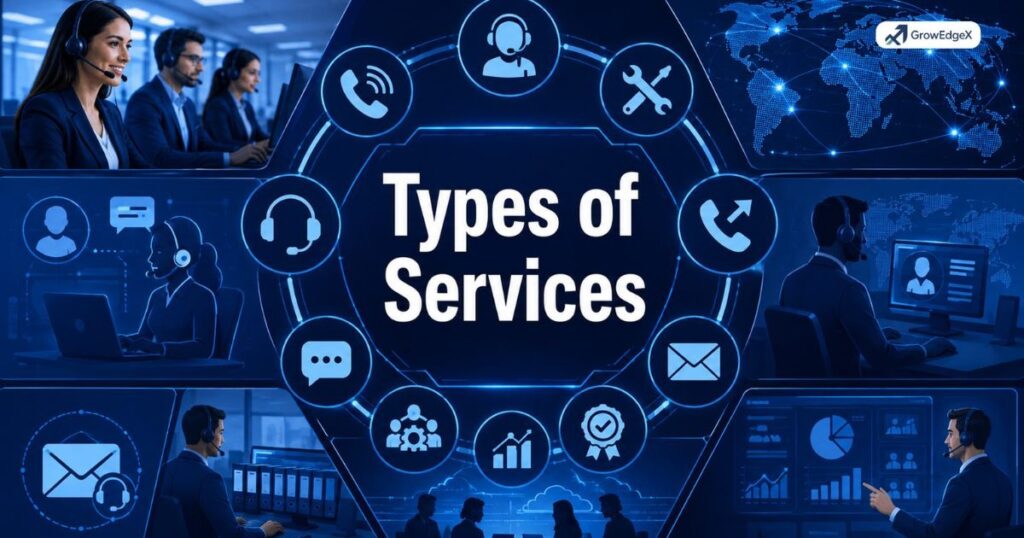
Outsourced call centers typically cover inbound support, outbound sales, technical help desk work, and back-office processing. Some vendors specialize narrowly. Others deliver full BPO services spanning billing questions, appointment scheduling, and everything in between.
Benefits
The biggest draw is cost. Industry benchmarks from GigaBPO put outsourcing savings at 60 to 70 percent versus running the same operation in-house. Add business scalability and 24/7 customer coverage, and it’s easy to see the appeal for growing companies.
Drawbacks and Risks
Nothing here is free of trade-offs. You lose some day-to-day control. Quality varies by agent and vendor. And if the vendor mishandles customer data, your company still owns the legal fallout, not them.
Key Considerations
Before signing anything, dig into vendor selection criteria like security certifications, training methods, and contract flexibility. A cheap rate means nothing if the vendor can’t protect data or hold onto brand consistency.
Types of Call Center Outsourcing Services
Not all outsourcing looks the same. Some vendors just answer the phone. Others build full customer experience solutions blending phone, chat, email, and social media into one connected system. Picking the right type depends entirely on where your business actually hurts right now.
Customer Support and Inbound Call Center Outsourcing
Inbound call center outsourcing handles incoming customer questions, complaints, and requests to keep response times low and satisfaction high. These are inbound support services, and agents usually work from scripts, knowledge bases, and your CRM to solve problems fast.
Example for better understanding:
Picture a mid-sized software company facing 500 support tickets a day during a product launch. Instead of hiring 15 new agents, they outsource inbound support for three months. Ticket backlog drops 60 percent within two weeks, without a single new in-house hire.
Outbound Call Center Outsourcing for Sales and Growth
Outbound call center outsourcing uses trained agents to make sales calls, follow up on leads, and run appointment-setting campaigns on your behalf. This covers outbound sales services, telemarketing outsourcing, and lead generation services all under one roof.
Example for understanding:
A regional insurance broker wants to expand into three new states. Rather than hiring local reps, they outsource outbound calling to a vendor with remote support teams trained in insurance compliance. Qualified leads climb 40 percent within 90 days.
Industry-Specific Call Center Outsourcing Solutions
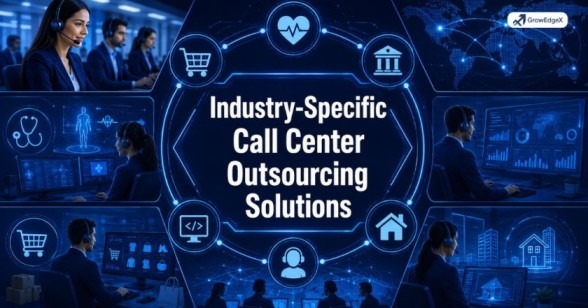
Different industries need different playbooks. A generic script won’t cut it for healthcare compliance or insurance claims work.
Ecommerce Call Center Outsourcing
Ecommerce brands need fast order tracking, returns handling, and holiday-season scaling. Outsourcing absorbs seasonal spikes without keeping permanent headcount on payroll year-round.
Healthcare Call Center Outsourcing
Healthcare providers need HIPAA-trained agents and strict data handling practices. Appointment scheduling and insurance verification are the most commonly outsourced tasks here.
Insurance Call Center Outsourcing
Insurance companies lean on outsourced teams for claims intake, policy questions, and renewal reminders, all under tight regulatory compliance requirements.
Multilingual Call Center Outsourcing
Businesses serving diverse customer bases need agents fluent in multiple languages. This keeps service consistent across regions without staffing a separate team per language.
Omnichannel Call Center Outsourcing Services
Omnichannel support connects phone, chat, email, and social media into one shared customer view, so agents see full context no matter which channel a customer used. That’s different from basic multichannel communication, where channels run in isolation without shared history.
Shared vs. Dedicated Call Center Outsourcing Models
A shared model pools agents across multiple clients, which lowers cost but weakens brand familiarity. A dedicated model assigns agents solely to your account, raising quality and price together. Growing companies often start shared, then move to dedicated once volume justifies the switch.
Inbound vs. Outbound Call Center Outsourcing: How to Decide
Choose inbound outsourcing first if support tickets are piling up, and choose outbound outsourcing first if your sales pipeline is running dry. The decision comes down to which pain is costing you more customers right now.
When Inbound Outsourcing Should Come First
Pick inbound first when response times slip and satisfaction scores fall. Protecting existing customers almost always pays off faster than chasing new ones.
When Outbound Outsourcing Should Come First
Pick outbound first when your sales team lacks the bandwidth to reach enough prospects. This works especially well for companies with a proven product but limited outreach capacity.
Budget and Risk Comparison
| Factor | Inbound Outsourcing | Outbound Outsourcing |
| Typical cost | Lower to moderate | Moderate to higher |
| Risk level | Lower, reactive work | Higher, compliance-sensitive |
| ROI timeline | Fast, within weeks | Slower, within months |
| Best for | Retention, satisfaction | Growth, pipeline building |
Governance Differences
Inbound teams need strong quality assurance processes and solid knowledge bases. Outbound teams need strict agent training programs around compliance, since cold-calling rules vary by state.
Onshore vs. Nearshore vs. Offshore Call Center Outsourcing Models
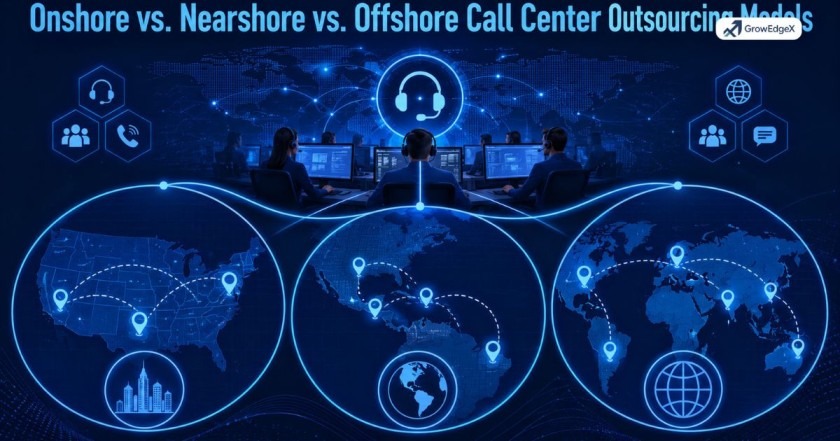
Onshore outsourcing costs the most but offers the closest cultural match, offshore costs the least but risks bigger communication gaps, and nearshore sits in between on both counts. Location changes everything, from price to accent to time zone coverage.
Onshore Call Center Outsourcing
Onshore means the vendor operates within your own country. You get the tightest cultural and language fit, but you pay the highest rate for it.
Nearshore Call Center Outsourcing
Nearshore providers sit in neighboring regions. For US companies, that usually means Mexico, Colombia, or the Caribbean. According to Call Force Global, Caribbean nearshore voice rates run about $12 to $18 per loaded hour, compared to $25 to $45 for US onshore staffing.
Offshore Call Center Outsourcing
Offshore hubs like the Philippines and India deliver the steepest cost reduction strategy available. NASSCOM data cited by industry researchers shows these two countries together handle more than 60 percent of offshore call center labor worldwide. The trade-off is bigger time zone gaps and a higher chance of communication friction.
What Most Businesses Underestimate
Companies routinely underestimate how much accent and cultural nuance shape customer trust, especially in emotionally sensitive industries like healthcare or finance.
Hypothetical Scenario
A fintech startup picks the cheapest offshore option to cut costs fast. Within two months, miscommunication complaints spike 25 percent. They switch to a nearshore virtual call center instead, and satisfaction scores recover within a quarter.
Benefits of Call Center Outsourcing
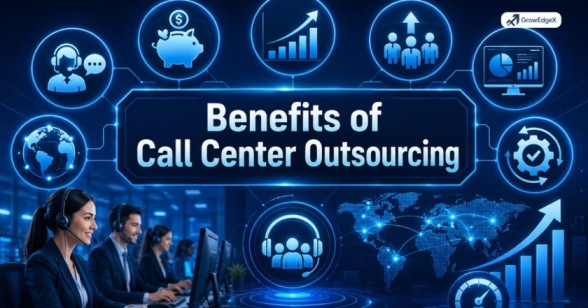
The core benefits of call center outsourcing are lower operating costs, faster scalability, specialized expertise, and round-the-clock coverage without building an internal department. Here’s what that looks like in practice.
Cost Efficiency Without Infrastructure Expansion
You skip office space, phone systems, and HR overhead entirely. This is one of the clearest paths to a real cost reduction strategy for a growing company.
Faster Scalability During Demand Fluctuations
Outsourcing partners flex staffing up or down based on demand, something in-house teams rarely pull off well on short notice.
Access to Specialized Expertise
Vendors bring agents who already understand service desk solutions and industry-specific workflows, saving you months of internal training time.
24/7 Customer Coverage
Global vendors offer round-the-clock support coverage using teams spread across time zones, a setup few in-house teams can match affordably.
Operational Focus on Core Business Functions
Outsourcing frees your internal team to focus on product and strategy instead of getting buried in daily customer interactions.
Risks of Call Center Outsourcing
The main risks of call center outsourcing are lost operational control, inconsistent quality, and data compliance exposure that stays with you even after you hand off the work. Nobody covers these in the sales pitch, so know them going in.
Reduced Operational Control
You lose some direct oversight of daily operations, which can slow down how fast internal issues get fixed.
Knowledge Transfer Gaps
If your vendor falls behind on product updates, agents give outdated answers, and that drags down your customer satisfaction metrics fast.
Quality Variability
Shared teams juggle multiple client accounts at once, which can dilute the attention and consistency your account actually needs.
Communication and Cultural Nuance Risks
Language gaps or cultural mismatches create friction, especially in sensitive conversations that need a delicate touch.
Data Handling and Regulatory Exposure
Your company stays responsible for compliance even when a vendor handles the data directly. Weak data handling practices on their side still creates legal exposure on yours.
Hidden Transition Costs
Switching vendors, or bringing services back in-house, usually costs more than expected once you factor in retraining and system migration.
Strategic Perspective
Outsourcing works best as a partnership, not a hand-off you forget about. Companies that stay active in workflow management and regular reviews get noticeably better long-term results.
Call Center Outsourcing Costs and Pricing Models
Call center outsourcing typically costs between $8 and $45 per hour depending on location and service complexity, with offshore the cheapest and onshore the most expensive. Several factors move that number up or down.
Service Scope
Basic inbound support costs less than complex technical support or multilingual coverage.
Shared vs. Dedicated Teams
Shared teams cost less per hour. Dedicated teams cost more but hold brand consistency better over time.
Location Model
Offshore pricing runs lowest, nearshore sits in the middle, and onshore costs the most, as the table below shows.
Call Volume and Complexity
Higher call volumes and more complex issues both push pricing upward, regardless of location.
Common Pricing Models for Outsourcing Call Center Services
| Pricing Model | How It Works | Best For |
| Per-minute billing | Pay based on call duration | Low, unpredictable volume |
| Per-agent monthly fee | Fixed cost per dedicated agent | Steady, predictable volume |
| Per-call pricing | Flat fee per resolved call | Simple, repetitive queries |
| Performance-based pricing | Tied to KPIs like resolution rate | Sales-focused outsourcing |
Hidden Cost Considerations
Watch for setup fees, technology licensing charges, and early-termination penalties. These rarely show up until the final invoice lands.
Explore More Insights: Healthcare and medical call center services in Plano
How to Choose Call Center Outsourcing Companies
Choosing the right call center outsourcing company means matching your objective, technology, and compliance needs against a vendor’s actual proven capabilities, not just their price sheet. Here’s the checklist that matters most.
Define Your Outsourcing Objective First
Know whether you need cost savings, scalability, or specialized expertise before you even request vendor proposals.
Evaluate Operational Maturity
Ask directly about agent training programs, onboarding timelines, and how they handle staff turnover, which averages 30 to 45 percent industry-wide according to QATC.
Review Technology Integration Capabilities
Confirm the vendor supports CRM integration systems and your existing communication channels without expensive custom development work.
Assess Data Handling and Compliance Posture
Request proof of security certifications and ask exactly how they meet regulatory compliance requirements relevant to your industry.
Clarify Scalability Limits
Ask how fast they can add or remove agents, and what minimum staffing commitments apply to your contract.
Compare Contract Flexibility
Favor vendors offering shorter initial terms with renewal options over long, rigid multi-year lock-ins.
Best Practices for Managing Outsourced Call Center Services
Managing outsourced call center services well means setting a regular review cadence, keeping knowledge current, and monitoring sentiment alongside speed. Signing the contract is the easy part. Managing the relationship is where results actually get made or lost.
Set a Consistent Performance Cadence
Review performance metrics weekly or biweekly so problems get caught early instead of after customers already noticed.
Formalize Knowledge Updates
Build a simple system for pushing product updates straight to your vendor’s knowledge base without delay.
Run Calibration Sessions
Regularly review call recordings together to align on tone, accuracy, and brand consistency.
Define Escalation Structure Early
Set clear rules for exactly when issues get kicked back to your internal team.
Monitor Sentiment, Not Just Speed
Track customer satisfaction metrics alongside handle time. Fast answers mean nothing if the customer hangs up frustrated anyway.
Reinforce Brand Alignment
Share brand voice guidelines clearly so outsourced agents sound like a natural extension of your company, not a stranger reading a script.
Why Growedgex Is a Smart Partner for Call Center Outsourcing
Growedgex approaches call center outsourcing differently. Instead of dropping your account into a generic shared queue, Growedgex builds trained teams around your specific product, tone, and customer base. Their focus on agent training programs and quality assurance processes means fewer knowledge gaps and steadier customer experience solutions from day one.
For businesses weighing outsourced customer service or outbound sales services, Growedgex offers flexible outsourcing models built around real business scalability, not rigid long-term lock-in.
Their approach to CRM integration systems and communication channels keeps your internal team fully visible into daily performance, closing the control gap that worries so many companies before they outsource in the first place.
Companies looking to strengthen customer retention strategy while cutting operational overhead often find that a well-matched partner like Growedgex delivers cost savings and measurable quality gains within the first few months.
Frequently Asked Questions About Call Center Outsourcing
What is call center outsourcing in simple terms?
Call center outsourcing means paying an outside company to answer your customer calls, chats, and emails instead of hiring your own in-house team.
How much does call center outsourcing cost?
Costs typically range from $8 to $15 per hour for offshore teams, $12 to $20 for nearshore, and $25 to $45 for onshore US-based teams, depending on service complexity.
Is call center outsourcing worth it for small businesses?
Yes, for most small businesses it is, since it avoids the cost of hiring, training, and managing staff directly while still delivering 24/7 customer coverage.
What is the difference between inbound and outbound outsourcing?
Inbound outsourcing handles incoming customer questions and support requests, while outbound outsourcing focuses on sales calls, lead generation, and telemarketing.
What are the biggest risks of call center outsourcing?
The biggest risks are reduced operational control, inconsistent quality between agents, and compliance exposure tied to how the vendor handles customer data.
Why Growedgex Is a Smart Partner for Call Center Outsourcing
Growedgex approaches call center outsourcing differently. Instead of dropping your account into a generic shared queue, Growedgex builds trained teams around your specific product, tone, and customer base. Their focus on agent training programs and quality assurance processes means fewer knowledge gaps and steadier customer experience solutions from day one.
For businesses weighing outsourced customer service or outbound sales services, Growedgex offers flexible outsourcing models built around real business scalability, not rigid long-term lock-in.
Their approach to CRM integration systems and communication channels keeps your internal team fully visible into daily performance, closing the control gap that worries so many companies before they outsource in the first place.
Companies looking to strengthen customer retention strategy while cutting operational overhead often find that a well-matched partner like Growedgex delivers cost savings and measurable quality gains within the first few months.
Conclusion
So, is call center outsourcing worth it? For most growing businesses, yes, but only if you go in with eyes open. Done right, it hands you scalability, round-the-clock coverage, and specialists you’d never afford to hire full-time.
Done carelessly, it hands a stranger your reputation and your customer data. The difference comes down to homework: the right pricing model, the right location, and a vendor who treats your account like a partnership instead of a queue. Nail those pieces, lock in clear service level agreements, and outsourcing stops being a gamble. It becomes one of the smartest growth levers your business has.