Every business wants happy customers. But happiness doesn’t happen by accident. It takes a real customer experience (CX) strategy built on research, clear goals, and steady follow-through.
If you’ve ever wondered how to create a customer experience strategy that actually works, you’re in the right place. This guide walks you through ten practical steps, from discovery to optimization, so you can build a CX strategy that boosts customer loyalty, drives customer retention, and turns first-time buyers into lifelong fans.
What is a customer experience strategy?

A customer experience strategy is a documented plan that guides how a business interacts with customers across every touchpoint. It covers everything from your website and support team to your billing emails and social media replies.
Instead of reacting to problems as they pop up, a strong strategy sets clear direction for customer experience management from day one.
Think of it as a roadmap. It tells every department, from marketing to product, how to create consistent, positive moments for customers. Without one, teams work in silos, and customers feel the disconnect. With one, every interaction feels intentional and part of a bigger picture.
The CX Strategy Canvas: A Practical Framework
Before diving into the steps, it helps to see the whole picture at once. The CX Strategy Canvas is a simple one-page framework that maps your customer insights, business goals, brand promise, and journey touchpoints side by side. It works like a business model canvas, but built specifically for experience planning.
Use it as a working document during team workshops. Fill in what you know about customer expectations, current pain points, and desired outcomes. Then revisit it as you complete each step below. It keeps your whole team aligned and stops the strategy from living only in one person’s head.
| Canvas Section | What Goes Here |
| Customer Insights | Survey data, interviews, customer feedback |
| Journey Touchpoints | Website, support, billing, social media |
| Business Goals | Revenue targets, retention goals, brand vision |
| Pain Points | Friction areas customers report most often |
| Success Metrics | Customer experience KPIs, scores, targets |
Unlock More CX Insights: What Is Customer Experience? Definition, Examples & Tips
Creating a successful customer experience strategy in 10 steps
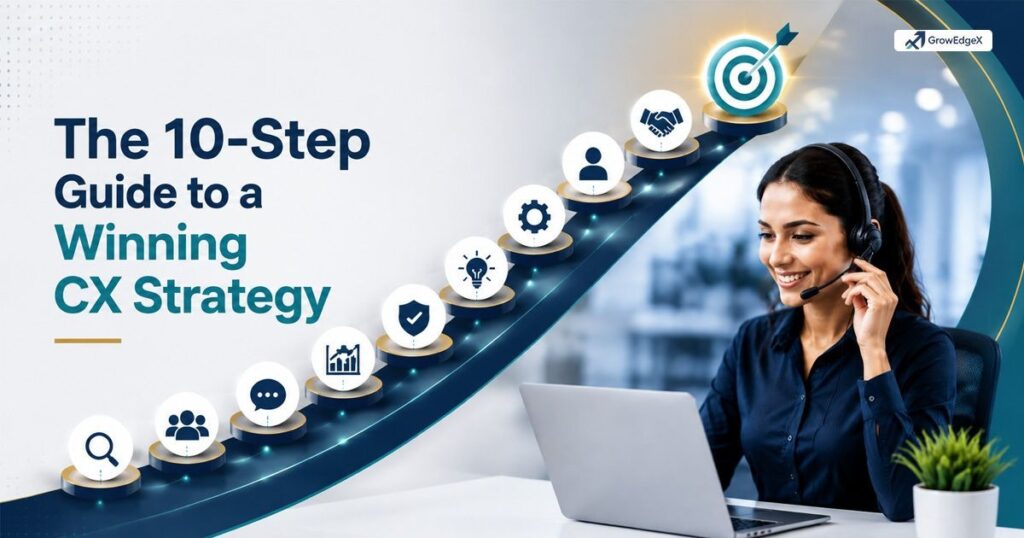
Building a customer experience strategy isn’t a one-time project. It’s a repeatable process. The ten steps below give you a clear path from research to daily execution, whether you’re a startup building CX from scratch or an enterprise refining an existing program.
Each step builds on the one before it. Skip ahead too fast, and you risk designing a strategy around guesses instead of real customer insights. Follow them in order for the best results.
Step 1: Discover
Discovery is where every good CX strategy starts. Sit down with leadership, frontline staff, and support teams to understand where the business stands today. Ask what’s working, what’s broken, and where customers complain the most.
This step also means auditing your current tools and data sources. You can’t fix what you can’t see. Pull together existing survey results, support tickets, and sales notes before you plan a single new initiative.
Step 2: Research your current customer
Once you understand your internal starting point, turn your attention outward. Talk directly to your customers through interviews, surveys, and customer feedback analysis. Look at your support logs for recurring complaints and praise.
This research shapes accurate customer personas, which represent your real buyer types and their goals. A persona built on guesswork leads your whole strategy astray. One built on actual data becomes the foundation for every decision that follows.
Step 3: Analyze business missions, values, and processes
A CX strategy has to fit inside your company’s bigger picture. It can’t contradict what your brand already stands for. This step forces you to look inward before you look at the customer journey itself.
Business objectives
Write down your top three business objectives for the next twelve months. Maybe it’s revenue growth, market expansion, or reducing churn. Your CX strategy needs to support these goals directly, not run parallel to them.
Brand promise
Your brand promise is the commitment you make to every customer, spoken or unspoken. If you promise fast shipping but customers wait two weeks, the experience breaks that promise. Write your brand promise down in one clear sentence and test it against your current operations.
Business ecosystem
Look at the wider ecosystem around your business too. This includes partners, vendors, and third-party tools that touch the customer journey. A great CX strategy accounts for every player, not just your own team.
Step 4: Align business processes with CX opportunity
Once you know your objectives and promises, look for the gap between them and your daily processes. Maybe your return policy doesn’t match your brand promise of easy service. Maybe your checkout flow adds unnecessary friction.
This step is about closing those gaps. Rework internal processes so they support the experience you want customers to have, not just the experience that’s easiest for your teams to deliver.
Step 5: Map your customer journeys
Customer journey mapping is one of the most valuable exercises in the whole process. It visually lays out every customer touchpoint, from first ad click to post-purchase support, across each customer journey stage.
Mapping the journey reveals customer pain points you didn’t know existed. It also highlights moments of delight worth protecting and amplifying. Most teams find at least a few surprising gaps once they map things out visually instead of relying on memory.
Step 6: Analyze your competitors, market, and industry
No CX strategy exists in a vacuum. Study what your direct competitors offer and where they fall short. Read their reviews, test their support channels, and note what frustrates their customers.
This competitive research often reveals quick wins. If competitors are slow to respond on live chat, that’s your opening. Market research keeps your strategy grounded in reality, not just internal wishful thinking.
Step 7: Define goals and SMART objectives
Vague goals like “improve customer experience” won’t get you far. Break them into SMART objectives instead: specific, measurable, achievable, relevant, and time-bound. For example, aim to raise your customer satisfaction score by 10 points within two quarters.
Tie each goal to a clear owner and deadline. This turns your customer experience objectives from wishful thinking into an accountable plan your whole team can track and support.
Step 8: Develop your CX strategy
With research, goals, and journey maps in hand, you’re ready to build the actual strategy document. This is where everything comes together into a written plan your teams can follow day to day.
Brand messaging and voice strategy
Decide how your brand sounds across every channel. Whether it’s an email, a chatbot reply, or a phone call, tone should stay consistent. A customer-centric strategy always speaks in a voice customers recognize and trust.
Engagement strategy
Plan how you’ll engage customers proactively, not just reactively. This might mean loyalty programs, personalized emails, or check-in calls after a purchase. A strong engagement strategy keeps customers connected between transactions, not just during them.
Step 9: Measure your CX strategy
You can’t improve what you don’t measure. Track metrics like Net Promoter Score, customer effort score, and customer lifetime value on a regular schedule. These numbers tell you whether your strategy is actually working.
Set up dashboards using customer experience analytics tools so teams can see progress without digging through spreadsheets. Review these numbers monthly at minimum, and share them widely so the whole company stays accountable to the results.
Step 10: Optimize your CX strategy
A CX strategy is never really finished. Use the data from Step 9 to spot what’s underperforming and adjust course. Maybe your onboarding emails need a rewrite, or your support team needs more training on empathy.
Treat optimization as an ongoing habit, not a yearly event. The businesses that win at customer experience improvement are the ones that keep testing, learning, and adjusting month after month.
How to improve your CX strategy
Improving your strategy over time comes down to consistency and listening. Keep collecting customer feedback through every channel available, from post-purchase surveys to social media comments. Small signals often point to bigger problems worth solving.
Invest in omnichannel customer service so customers get the same quality of help whether they call, email, or message you on social media. Consistency across channels is one of the clearest signs of a mature CX program, and research shows companies with strong omnichannel strategies retain far more customers than those without one.
What are the benefits of a customer experience strategy?

Benefits of a customer experience strategy:
- Higher customer retention, since customers stick around longer when every interaction feels consistent and reliable
- Stronger customer loyalty, because loyal customers forgive occasional mistakes more easily than new ones
- More repeat purchases, as a good experience turns one-time buyers into recurring revenue
- Faster revenue growth: Forrester’s 2026 CX Index found top-performing CX companies grow revenue roughly six times faster than low performers
- Lower acquisition costs, since loyal customers refer friends and family, which cuts down on marketing spend
- Better brand resilience, as strong CX builds a buffer that protects the business when things occasionally go wrong
- Clearer competitive edge, since in crowded markets, experience often becomes the deciding factor over price or product alone.
What are some of the challenges to creating a CX strategy?
Challenges to creating a customer experience strategy:
- Data spread across too many tools, so no one sees the full customer picture
- Slow buy-in from leaders, especially when CX work takes time to show results
- Tight budgets that limit spending on the right tools and training
- Not enough trained support staff who focus on the customer, not just closing tickets
- Teams working out of sync, since marketing, sales, and support often chase different goals
- Hard to prove ROI early on, which makes it tough to win more budget
- Pushback from staff used to old ways of working, even when those ways create friction for customers.
Examples of successful CX strategies
Real-world examples make this less abstract. Apple built its entire retail experience around simplicity and hands-on product trial, turning stores into brand experiences rather than just sales floors. Zappos famously trains support agents to spend as much time as needed on a call, prioritizing genuine help over speed metrics.
Amazon uses customer sentiment analysis and purchase history to power one-click reordering and personalized recommendations. Each of these companies built their strategy around a clear brand promise, then aligned every process to support it consistently.
Build a customer experience strategy with GrowEdgeX

Building all ten steps in-house takes time, tools, and trained people that many growing businesses simply don’t have yet. GrowEdgeX helps companies design and run personalized customer experience programs without the overhead of building a full team from scratch.
From omnichannel customer journey support to customer experience automation and reporting, GrowEdgeX gives you the people and processes to execute your strategy well, not just plan it on paper. If you’re ready to turn this guide into action, reach out to GrowEdgeX to talk through what your business actually needs.
FAQ’s
What is a customer experience strategy?
A customer experience strategy is a documented plan for how a company delivers consistent, positive interactions across every customer touchpoint, from first contact through post-purchase support.
How do you build a customer experience strategy?
You build one through research, journey mapping, goal-setting, and continuous measurement. Start with discovery, study your customers directly, then design a plan aligned with your brand promise and business goals.
What are the key steps in creating a customer experience strategy?
The key steps include discovery, customer research, business analysis, process alignment, journey mapping, competitor research, goal-setting, strategy development, measurement, and ongoing optimization.
Why is customer journey mapping important in a CX strategy?
Journey mapping reveals pain points and moments of delight across every stage of the customer relationship. Without it, teams often miss friction that customers experience regularly but never report.
What are common challenges in building a customer experience strategy?
Common challenges include siloed data, limited leadership buy-in, tight budgets, and a shortage of trained support staff. Most of these ease once early wins show measurable results.
How do you measure the success of a customer experience strategy?
Success is measured through metrics like Net Promoter Score, customer satisfaction score, customer effort score, and customer lifetime value, tracked consistently through customer experience analytics tools.
Why is customer feedback important for customer experience?
Customer feedback shows you exactly where the experience breaks down, straight from the people living it. It replaces internal guesswork with real, actionable customer insights.
How does technology improve customer experience?
Technology improves customer experience through automation, personalization, and unified data. Tools that connect customer relationship management systems with support and marketing platforms make service faster and more consistent.
How often should a customer experience strategy be updated?
Most companies should review their CX strategy quarterly and make small adjustments monthly based on fresh customer feedback and performance data.
What makes a customer experience strategy effective across digital channels?
An effective digital CX strategy stays consistent across every channel, uses real customer data for personalization, and gives customers a way to move between channels without repeating themselves.
Conclusion
A strong customer experience strategy doesn’t happen overnight, but it doesn’t need to be complicated either. Follow the ten steps in this guide, from discovery through optimization, and you’ll build a plan grounded in real customer insights instead of guesswork.
The businesses that treat customer experience as an ongoing habit, not a one-time project, are the ones that keep customers coming back. Start small, measure often, and let the data guide your next move.