Your bank balance says one thing. Your gut says another. And somewhere between the two, a small business owner is trying to figure out if payroll clears next Friday. That’s the exact moment most owners start searching for bookkeeping services for small businesses, usually a little later than they should have.
This guide breaks down what these services actually cover, what they cost, and how the right partner turns messy numbers into a clear picture you can act on. No jargon, no fluff, just what you need to make a smart call.
What Do Bookkeeping Services for Small Business Actually Cover?
Bookkeeping isn’t just data entry with a fancier name. A solid bookkeeping service tracks every dollar moving through your business: sales, expenses, payroll, and vendor payments. It reconciles your bank accounts monthly, so nothing slips through unnoticed. It also keeps your books tax-ready year-round instead of scrambling every April.
Picture a small landscaping company in Plano. The owner used to track expenses in a shoebox of receipts, literally. Once a small business bookkeeping partner took over, invoices got categorized correctly, cash flow became visible in real time, and tax season stopped feeling like a fire drill. That shift, from reactive chaos to proactive clarity, is what good bookkeeping delivers.
Bookkeeping vs. Accounting: Where’s the Line?
Owners mix these terms up constantly, and honestly, that’s understandable. Bookkeeping handles the daily recording of transactions. Accounting takes that data and interprets it, building financial statements, filing taxes, and offering strategic advice.
| Function | Bookkeeping | Accounting |
| Transaction recording | Yes, daily or weekly | Not the primary focus |
| Bank reconciliation | Yes | Sometimes reviewed |
| Financial statement prep | Rarely | Yes |
| Tax filing | Rarely | Yes |
| Strategic financial advice | No | Yes |
Think of bookkeeping as the foundation and accounting as the blueprint built on top of it. You genuinely need both, but most small businesses start with bookkeeping services first since that’s where the daily financial mess actually lives.
Explore More: Healthcare BPO Services
Types of Bookkeeping Services for Small Business
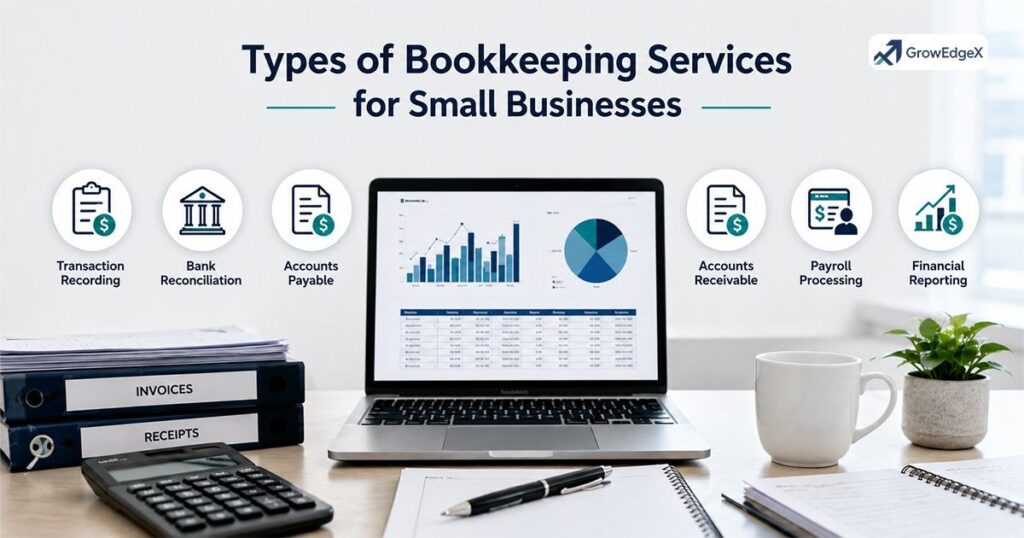
Understanding the various bookkeeping services for small businesses in USA can help you choose the right solution for your financial needs.
Bank and Credit Card Reconciliation
This service matches every transaction against your bank and credit card statements each month. It catches errors, duplicate charges, and missing entries before they turn into bigger problems.
Accounts Payable Management
Accounts payable management tracks vendor bills and schedules payments on time. It prevents late fees and keeps supplier relationships running smoothly.
Accounts Receivable Management
This service handles invoicing and follows up on unpaid client balances. It keeps cash flowing in in and reduces the time money sits uncollected.
General Ledger Maintenance
The general ledger records every transaction in its correct category. Accurate categorization here makes every other financial report reliable.
Payroll Processing
Payroll processing calculates employee wages, taxes, and benefits accurately each pay period. It keeps your business compliant with labor and tax regulations.
Financial Statement Preparation
This service produces your profit and loss statement, balance sheet, and cash flow report. These documents show exactly where your business stands financially.
Sales Tax Tracking and Filing
Sales tax tracking calculates what you owe based on state-specific rules and files it on time. Missing this step often leads to penalties down the road.
Expense Tracking and Categorization
This service sorts every business expense into the right category as it happens. Clean categorization makes tax season and budgeting far easier.
Cash Flow Management
Cash flow management monitors money coming in and going out in real time. It helps you spot shortfalls before they become emergencies.
Budgeting and Forecasting
This service uses past financial data to predict upcoming expenses and revenue. It gives you a roadmap instead of a guessing game.
Inventory Bookkeeping
Inventory bookkeeping tracks stock levels and cost of goods sold accurately. It’s essential for retail and e-commerce businesses managing physical products.
Tax-Ready Bookkeeping
This service keeps your books accurate and organized all year long. When tax season arrives, everything is ready instead of scattered.
Software Setup and Migration
This service sets up or transfers your bookkeeping onto platforms like QuickBooks or Xero. It reduces friction and keeps your records in one reliable system.
Financial Reporting and Dashboards
This service delivers regular reports that summarize your business’s financial health. It gives you a clear picture without digging through spreadsheets yourself.
Why Small Businesses Are Outsourcing Bookkeeping Right Now
Hiring a full-time, in-house bookkeeper costs more than most owners expect once you add salary, benefits, and software licenses together. According to data from the Bureau of Labor Statistics, the median annual wage for bookkeeping and accounting clerks in the U.S. sits well above what most small businesses budget for a part-time financial function.
Outsourced bookkeeping services flip that math. Instead of a full salary, you pay for exactly the hours or scope you need. A five-person retail shop doesn’t need the same bookkeeping hours as a twenty-person manufacturing company, and a flexible outsourced arrangement adjusts to that reality without forcing you into a rigid headcount decision.
There’s also the expertise gap. Many small business owners simply aren’t trained in accounting standards, tax rules, or proper categorization. A professional bookkeeping team already knows this terrain, which means fewer costly mistakes down the road.
The Real Cost of Bad Bookkeeping for Small Businesses in the USA
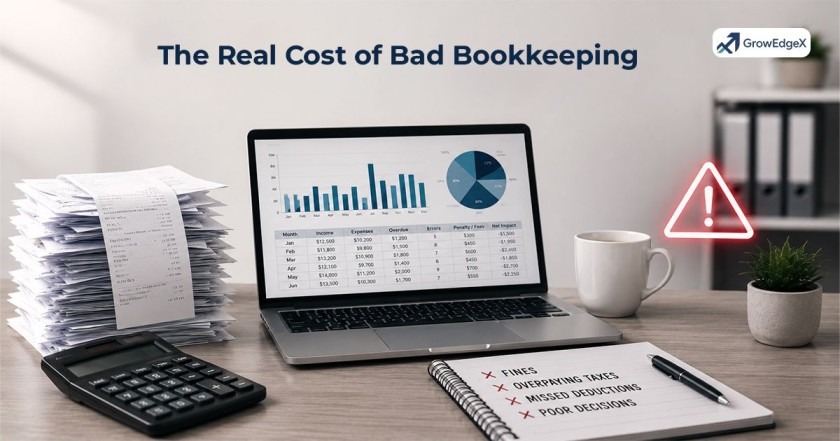
Skipping proper bookkeeping doesn’t save money. It just delays the bill, and the delayed version is usually bigger. Missed deductions during tax season cost real dollars. Late vendor payments damage relationships and sometimes trigger fees. Worse, inaccurate books make it nearly impossible to know if your business is actually profitable or just busy.
Consider a small café owner who assumed the business was thriving because the register stayed full all day. Without proper bookkeeping, nobody noticed that supplier costs had crept up nearly 20% over six months.
By the time the owner caught it through a tax preparer’s questions, months of thin margins had already passed unnoticed. That’s the quiet cost of skipping small business bookkeeping: not a dramatic collapse, just a slow leak of profit nobody tracked.
Key Benefits of Professional Bookkeeping Services
Accurate books do more than keep the IRS happy. Here are some key benefits that come with getting your bookkeeping right.
- Real-time visibility into cash flow and business health
- Fewer costly errors in categorization and tax filing
- Faster, cheaper, and less stressful tax season prep
- Accurate records that build credibility with investors and lenders
- More time back for owners to focus on running the business
- Early warning signs of slow quarters or cash flow problems
- Organized financial data that supports smarter budgeting decisions
- Reduced risk of missed deductions or compliance penalties
Signs Your Small Business Needs Bookkeeping Help
A few warning signs tend to show up before an owner admits the problem out loud. Bank reconciliations that haven’t happened in months are one. Invoices going out late, or not at all, are another. If you genuinely don’t know your current profit margin without opening three different spreadsheets, that’s a clear signal too.
Tax time panic is probably the most common trigger. If every April brings a scramble to find receipts and reconstruct a year of transactions, outsourced bookkeeping services solve that specific pain point directly, and they solve it permanently, not just for one tax season.
What is the future of bookkeeping?
The future of bookkeeping is shifting from manual data entry toward strategic financial advising. Cloud platforms and AI now automate routine tasks like categorization and reconciliation, while human bookkeepers focus on reviewing that output and offering forward-looking business advice.
Can ChatGPT do bookkeeping?
Not on its own. ChatGPT lacks real-time bank connections and built-in compliance features, but it works well as an assistant for categorizing transactions, drafting client emails, and analyzing financial statements alongside a professional bookkeeper.
How to Choose the Right Bookkeeping Partner
Not every bookkeeping provider fits every business. Start by checking their experience with your industry specifically. A bookkeeper familiar with restaurant margins handles different challenges than one who works mainly with law firms or retail shops.
Software compatibility matters too. Ask whether they work within QuickBooks, Xero, or whatever platform you already use, since switching systems adds unnecessary friction. Communication style deserves attention as well. You want a partner who explains numbers clearly, not one who buries you in accounting jargon during every monthly check-in.
Finally, ask about turnaround time and reporting frequency. A good partner delivers monthly reconciled statements, not a once-a-year data dump right before tax deadlines.
GrowEdgeX: Bookkeeping Services Built for Growing Businesses in Texas
GrowEdgeX, based in Plano, Texas, provides bookkeeping services for small businesses across the Dallas-Fort Worth area, handling everything from monthly reconciliations to payroll-ready financial reporting.
Every engagement starts with a clear picture of your current books and a straightforward plan to get them current, accurate, and tax-ready.
For small businesses across Plano, Dallas, Fort Worth, Frisco, McKinney, and Allen, working with a local partner means faster onboarding and a team that already understands the Texas business landscape, not a distant vendor learning your industry from scratch.
If your books need real attention, GrowEdgeX offers a free consultation to walk through exactly what your business needs.
FAQ’s
How much do online bookkeeping services for small business typically cost?
Costs vary based on transaction volume and scope, but outsourced bookkeeping generally costs far less than hiring a full-time, in-house bookkeeper once salary and benefits are factored in.
Can small businesses handle bookkeeping themselves?
Some can, especially in the earliest stages. However, as transaction volume grows, DIY bookkeeping tends to consume time better spent running the business, and errors become more costly.
How often should a small business reconcile its books?
Monthly reconciliation is the standard recommendation. Waiting longer makes errors harder to trace and catch early.
Do bookkeeping services help with tax preparation?
Bookkeeping services keep your records organized and accurate, which makes tax preparation faster and cheaper, though the actual tax filing is usually handled by an accountant or CPA.
What are 3-5 skills that make a great bookkeeper?
A great bookkeeper needs proficiency in accounting software, sharp attention to detail, solid knowledge of financial regulations, clear communication, and strong problem-solving abilities.
Is AI replacing bookkeepers?
No. AI handles repetitive tasks like data entry and receipt matching, but bookkeepers still provide the judgment, accuracy checks, and financial advice a business actually needs.
Conclusion
Bookkeeping services for small business turn financial guesswork into a clear, reliable picture of where your money actually goes. From accurate monthly reconciliations to tax-ready records, the right partner saves time, reduces costly errors, and gives you the visibility needed to make confident decisions.
Whether you’re running a café, a landscaping company, or a growing retail shop, clean books aren’t a luxury. They’re the foundation everything else depends on.