If you run a business in the US, you’ve probably heard both words tossed around in the same breath. But here’s the truth: outsourcing and offshoring are not the same thing, and mixing them up can lead to the wrong hiring decision.
The difference between outsourcing and offshoring comes down to what you’re doing versus where you’re doing it. Outsourcing means handing a task to someone outside your company. Offshoring means moving that task to another country, whether it’s your own team or someone else’s. This guide walks you through both terms, shows you real-world examples, and helps you figure out which path fits your business in 2026.
What is outsourcing?
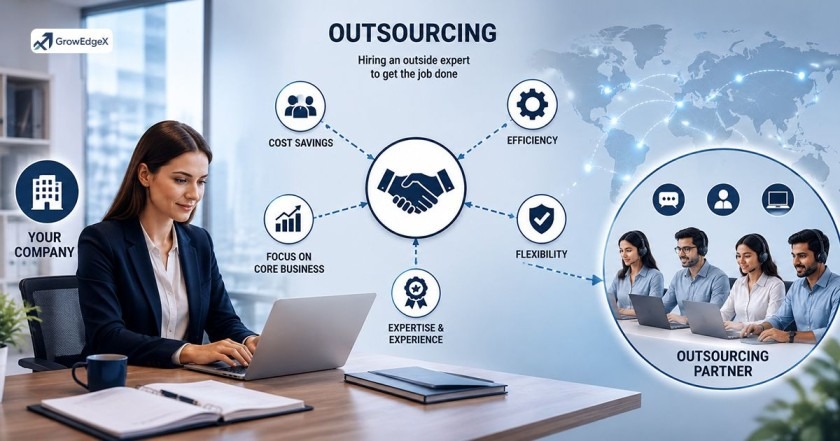
So the question is, what is outsourcing in business, right? It’s simple: outsourcing happens when a company hires an outside firm or freelancer to handle work that used to sit inside the office. Think payroll, IT support, customer service, or even marketing. Instead of building an internal team for every function, companies turn to third-party service providers that specialize in that work.
This isn’t a new idea. Companies have used outsourcing strategies for decades to cut costs and focus on what they do best. The provider you hire could be based down the street or across the globe. That’s the key point people miss: outsourcing says nothing about location. It’s purely about who does the work, not where they sit while doing it.
Examples of outsourcing in businesses
Picture a small e-commerce company in Texas. They don’t have an in-house accountant, so they hire a bookkeeping firm to handle their books every month. That’s outsourcing. A law firm in New York might hire an outside agency to manage its social media. That’s outsourcing, too. Even outsourcing for small businesses often starts this way, with one or two functions handed off before scaling further.
Bigger companies do it too, just at a larger scale. A manufacturing firm might outsource its logistics to a freight company. A tech startup might use business process outsourcing for customer support, hiring a call center company instead of building one from scratch. The pattern stays the same: a task leaves the building, and an expert outside firm picks it up.
Advantages and Disadvantages of Outsourcing
| Category | Advantages of Outsourcing | Disadvantages of Outsourcing |
| Cost | Reduces operational costs (no salaries, benefits, or office space) | Hidden costs (vendor fees, contract changes) |
| Focus | Allows focus on core business activities | Less focus/control over outsourced tasks |
| Talent | Access to skilled professionals | Quality may vary depending on the provider |
| Efficiency | Faster execution with experienced teams | Dependency on third-party performance |
| Scalability | Easy to scale services up or down | Limited flexibility in some contracts |
| Communication | Professional support and structured processes | Communication gaps or delays |
| Control | Saves management time on non-core tasks | Less direct control over operations |
| Security | Vendors may have proper systems in place | Data security and confidentiality risks |
| Setup | Quick to implement without hiring internally | Initial onboarding and training required |
What is offshoring?
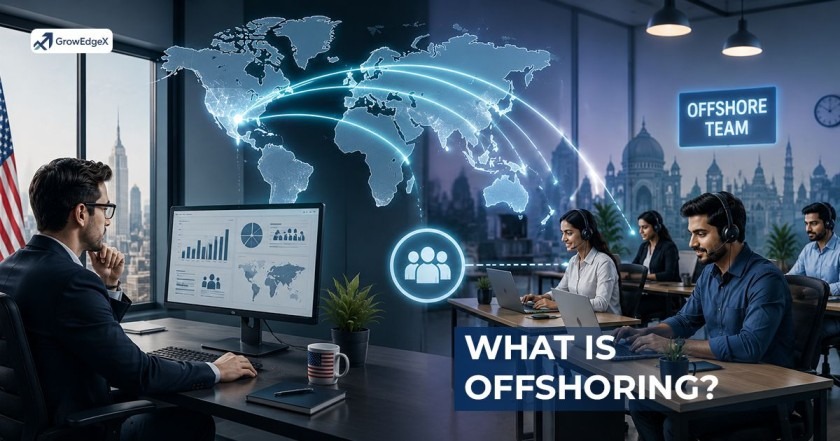
Now let’s flip to the other half of the equation. What is offshoring with an example? Offshoring happens when a company moves part of its operations, or its own employees, to another country. The key difference from outsourcing is ownership. With offshoring, the work might still belong to your company. You’re just doing it overseas instead of locally.
This is where offshore business expansion comes into play. A US software company might open its own development office in India rather than hiring an outside firm. That’s offshoring without outsourcing.
Of course, many companies blend the two, hiring offshore outsourcing services where a foreign company handles the work on their behalf. That blend is so common that the lines blur in everyday conversation, but the core idea stays distinct.
What is offshoring in business?
In plain terms, offshoring is about geography first. A company looks at its resource allocation and decides it makes more sense to handle a certain function in another country. Maybe labor costs are lower there. Sometimes the talent pool is deeper too. Or the time zone lines up well for round-the-clock coverage.
This is also where overseas operations management becomes a real skill, not just a buzzword. Running a team or office on the other side of the planet means dealing with different labor laws, cultural norms, and sometimes a completely different work week.
Companies that do this well invest heavily in offshore team management, building systems and check-ins that keep everyone aligned despite the distance.
Offshoring Examples in Various Industries
Manufacturing is probably the most familiar example. For decades, US clothing and electronics brands have shifted factories to China, Vietnam, and Bangladesh to take advantage of lower production costs. That’s classic offshoring.
In tech, it looks a little different. Many American software firms run their own engineering hubs in India, the Philippines, or Eastern Europe. Outsourcing payroll to India is one specific and very common example, where US companies either set up their own offshore payroll team or contract an offshore IT company in India to manage it.
The financial sector offshores too, with banks running back-office processing centers overseas to handle transactions and compliance checks around the clock.
Advantages and disadvantages of offshoring
| Category | Advantages of Offshoring | Disadvantages of Offshoring |
| Cost | Lower labor costs (50–70% savings) | Hidden costs (management, travel, setup) |
| Talent | Access to a global skilled workforce | Possible skill gaps or inconsistent quality |
| Productivity | 24/7 work cycle (round-the-clock output) | Delays due to time zone differences |
| Scalability | Easy to scale teams for large projects | Complex coordination for large teams |
| Communication | Global collaboration & diverse input | Language barriers and communication gaps |
| Culture | New ideas and innovation from diverse cultures | Cultural misunderstandings |
| Security | Some offshore firms follow strong compliance systems | Data security & compliance risks (GDPR, HIPAA) |
| Management | Ability to build global operations | Requires strong oversight and dedicated management |
Outsourcing Vs. Offshoring
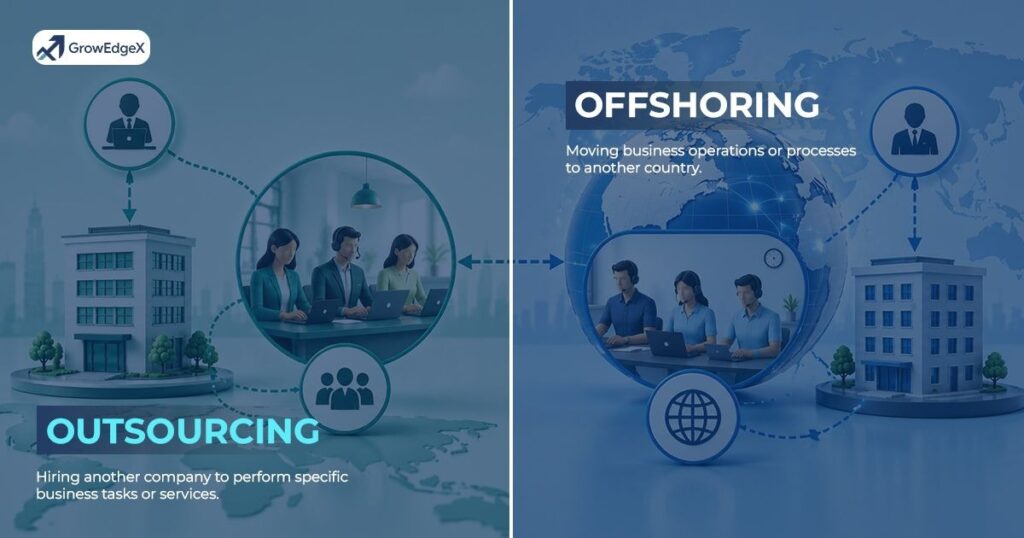
Here’s the core outsourcing vs offshoring comparison. Outsourcing is about who does the work. Offshoring is about where the work happens. You can outsource locally, hiring a firm in your own city.
Think of it this way: outsourcing answers the question “should I do this myself or pay someone else?” Offshoring answers a completely different question: “Should this work happen here or somewhere else?” These are two separate decisions that companies often make together, but they don’t have to be tied to one another.
| Factor | Outsourcing | Offshoring |
| Core focus | Who performs the work | Where the work is performed |
| Location | Can be local or international | Always involves another country |
| Ownership | Often, a third-party vendor | Can be your own team or a vendor |
| Common goal | Cost reduction, expertise access | Lower labor costs, global talent access |
| Example | Hiring a US marketing agency | Opening a development office in India |
| Risk profile | Vendor reliability, contract terms | Time zones, compliance, cultural gaps |
A simple way to remember it: outsourcing vs in-house is about ownership of the task, while offshoring vs onshore is about location of the task. Once you separate those two questions, the whole topic gets a lot less confusing.
Tips for Choosing Between Offshoring and Outsourcing
- Start by clearly defining your business goals
- If your team is overloaded with routine work, choose outsourcing to handle non-core tasks
- If your main goal is cost reduction at scale, go for offshoring
- Outsourcing is better when you want to delegate tasks without changing your team structure
- Offshoring is ideal for building a dedicated long-term team at a lower cost
FAQ’s
What are examples of outsourcing vs offshoring?
Outsourcing means hiring a third party (local or global), while offshoring means moving work to another country; for example, outsourcing customer support to a local agency vs offshoring it to a team in Pakistan or India for cost efficiency.
What is the difference between outsourcing vs offshoring vs offshore?
Outsourcing means external delegation, offshoring means relocating work overseas, and offshore refers to the foreign location itself.
What is the difference between outsourcing vs insourcing?
Outsourcing uses external providers, while insourcing relies on in-house teams for better control and operations.
How are outsourcing and offshoring used in strategic management?
They are strategies to reduce costs, improve efficiency, and access global talent while focusing on core business functions.
What is the meaning of outsourcing in business?
Outsourcing is contracting tasks to third-party providers to save costs, increase efficiency, and gain expert support.
Conclusion
So, what’s the real difference between outsourcing and offshoring? Outsourcing is about handing work to outside experts, while offshoring is about moving work to another country, whether you keep it in-house or not.
Both strategies offer real outsourcing benefits and risks, and both can drive significant business cost optimization when used correctly. The smartest move isn’t picking one over the other forever. It’s understanding your goals, testing carefully, and choosing the approach, or the blend of both, that actually fits where your business stands today.