Does a small business call center actually make sense for a company your size? Short answer: yes, and probably sooner than you think. Missed calls mean missed money, and most small businesses lose more of both than they realize.
This guide breaks down how call centers work, what skills great agents need, and how to measure real results. You’ll also see how to choose between an in-house team and outsourced call center solutions. By the end, you’ll know exactly what fits your business and your budget.
Benefits of Call Centers
A call center does more than answer phones. It protects your customer relationships during the moments that matter most, like a frustrated customer calling with a broken order or a new lead calling right after seeing your ad. Every one of those calls either builds trust or loses it.
Small businesses that add call center services often see fewer missed calls, faster response times, and stronger customer experience scores. Beyond that, a good call center frees up your own team. Instead of juggling phones and daily tasks, your staff can focus on running the business while trained agents handle customer inquiries around the clock.
How Do Call Centers Work?
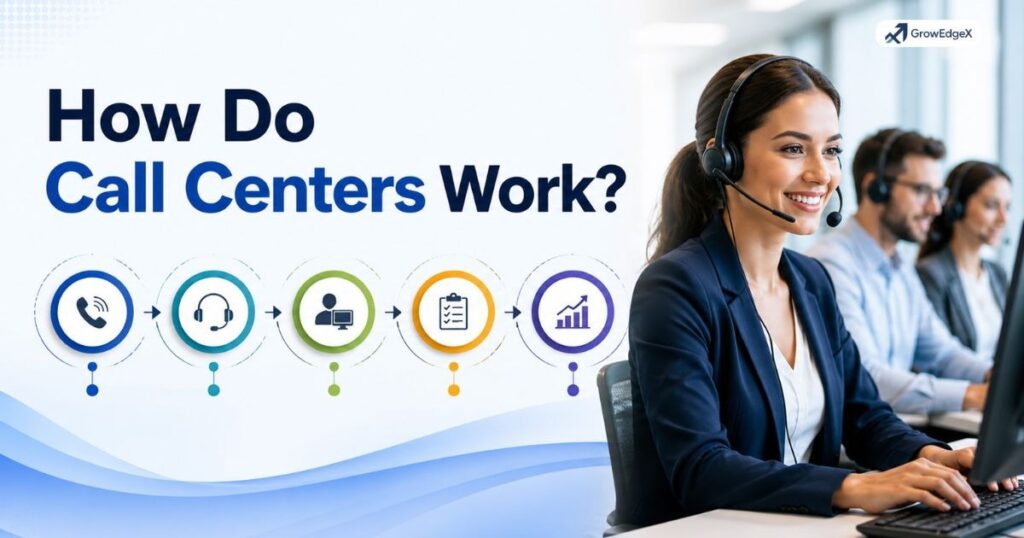
At its core, a call center is a hub where agents handle incoming or outgoing calls using specific software, scripts, and data systems. Calls route through a phone system, get logged, and often connect to a CRM integration so agents see customer history instantly. That context turns a random caller into someone the agent actually recognizes.
Behind the scenes, call centers rely on call routing technology, quality monitoring tools, and reporting dashboards. These systems track everything from call length to resolution rate, giving business owners a clear picture of what’s happening on every call, even the ones they never hear personally.
Explore More Insights: Contact Centers vs Call Centers
Process Flow in a Call Center
Here’s the basic flow. A call comes in or an agent dials out. The system routes it to an available, trained operator. The agent pulls up the customer’s account, listens, resolves the issue or logs the lead, then updates the CRM. Supervisors review flagged calls later for quality and coaching.
| Step | What Happens |
| 1. Call Received | Routed through IVR or direct line to next available agent |
| 2. Identification | Agent pulls customer record from CRM |
| 3. Resolution | Issue solved, appointment booked, or lead qualified |
| 4. Documentation | Call notes and outcome logged |
| 5. Follow-Up | Escalation or callback scheduled if needed |
Benefits of Call Centers
Beyond faster response times, call centers give small businesses something bigger: consistency. Every caller gets the same quality of service, whether it’s 9 a.m. on Monday or 11 p.m. on a Saturday. That kind of around-the-clock support builds a reputation you can’t buy with ads alone.
Cost matters too. A well-run affordable call center solutions provider often costs far less than hiring, training, and managing an internal team. You get trained staff, mature technology, and proven processes without the overhead of building it all from scratch.
Customer Interaction and Issue Resolution
Every call is a small test of trust. A caller with a billing question, a shipping delay, or a product question wants one thing: a real person who actually helps. Well-trained professional call agents solve problems on the first call whenever possible, which keeps customers loyal instead of frustrated.
Quick issue resolution also protects your online reputation. Unhappy customers leave reviews. Customers who get fast, friendly help usually don’t, or they leave a good one instead.
Types of Call Centers
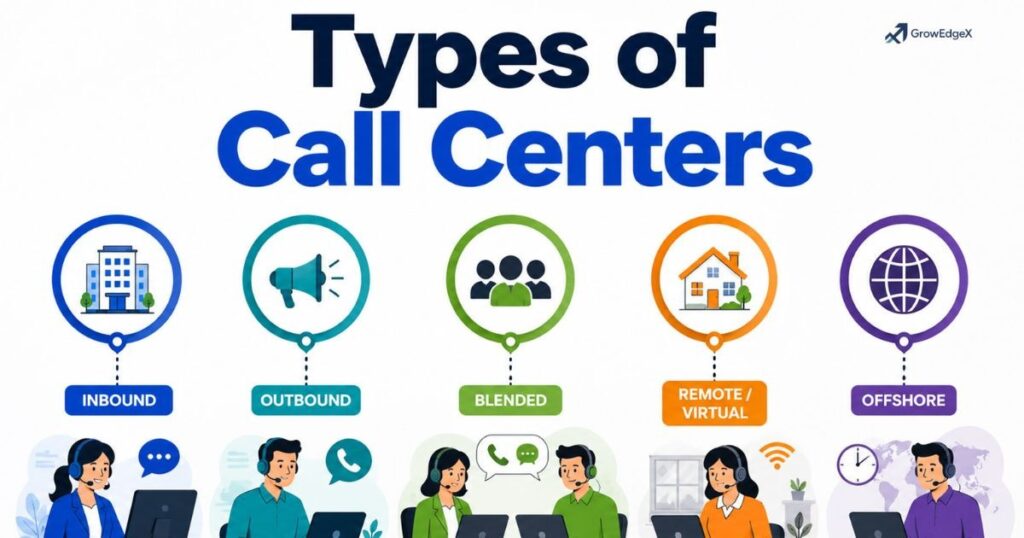
Not every call center works the same way. Some only take calls. Some only make them. Others blend both, or run entirely online. Picking the right type depends on what your business actually needs, whether that’s support, sales, or a mix of both.
Understanding these categories helps you ask smarter questions when you start comparing providers. A vendor built for outbound sales calls won’t necessarily excel at handling support tickets, so match the type to your goal first.
Inbound Call Centers
Inbound call center services handle calls that customers initiate. Think support lines, order questions, or appointment requests. These teams specialize in live operator support, answering customer inquiries quickly and accurately without making the caller repeat themselves twice.
Inbound teams work best for businesses focused on customer service, healthcare scheduling, or general support where responsiveness matters most.
Outbound Call Centers
Outbound call center services flip the script. Agents make the calls, often for lead generation services, follow-ups, surveys, or sales support services. These teams chase hot leads, confirm appointments, or reconnect with customers who went quiet.
Outbound work demands a different skill set: persistence, persuasion, and the ability to handle rejection gracefully, since not every call turns into a sale.
Virtual or Remote Call Centers
Virtual call centers run entirely online, with agents working from various locations instead of one physical office. This setup supports remote customer support at scale, often reducing costs since there’s no need for a large physical facility.
For small businesses, virtual teams offer flexibility. You can scale up during busy seasons and scale down during slow ones, without the headache of hiring and firing staff directly.
Omnichannel Call Centers
Omnichannel centers go beyond phone calls. They handle email, live chat, SMS, and social media messages, all through one unified system. Customers today jump between channels constantly, and omnichannel setups keep that experience seamless.
This matters especially for e-commerce support, where a customer might start a chat, follow up by email, then call to finish the conversation, all while expecting the agent to already know the full story.
Essential Call Center Rep Skills
The best call center technology in the world still needs a skilled human behind it. Great agents combine technical know-how with genuine people skills, and that combination is harder to find than most business owners expect.
Hiring and training for these skills takes time, which is exactly why many small businesses choose outsourced teams that already have this talent in place, tested and ready to go.
Communication and Active Listening
Clear communication starts with listening, not talking. Trained operators know how to let a customer finish, ask the right follow-up question, and confirm they’ve understood the actual problem before jumping to a solution.
Empathy and Emotional Intelligence
Customers calling with a complaint aren’t just annoyed, they’re often stressed. Agents with strong emotional intelligence read the tone behind the words and respond with patience instead of a scripted, robotic reply.
Problem-Solving and Critical Thinking
Not every call fits a script. Great agents think on their feet, weigh options quickly, and find solutions even when the situation doesn’t match the training manual exactly.
Collaboration and AI Partnership
Modern call center technology increasingly pairs agents with AI tools that suggest responses, flag sentiment, and speed up data entry. The best agents don’t fight this shift, they use it, letting AI handle repetitive tasks while they focus on the human parts of the conversation.
How to Measure Call Center Success
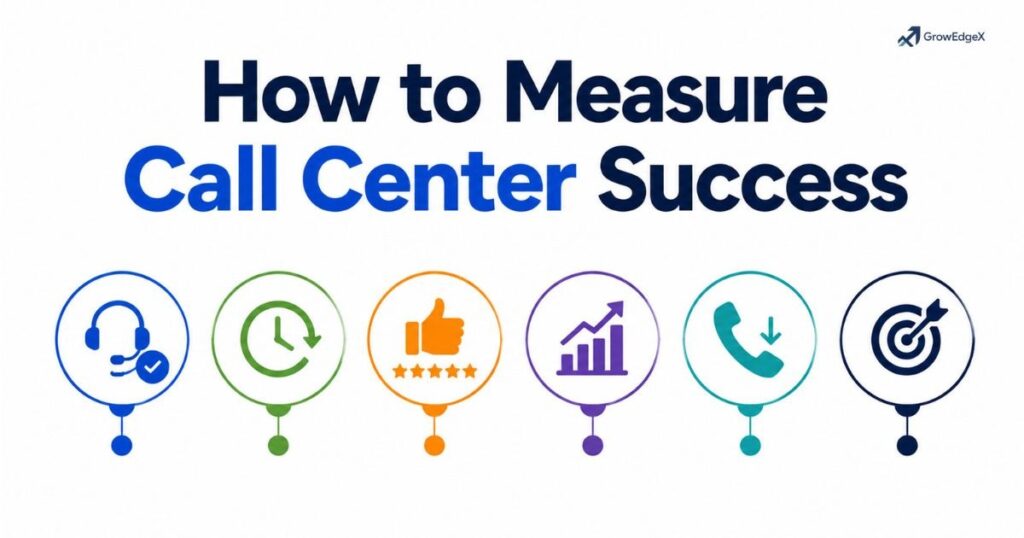
You can’t improve what you don’t measure. Successful call centers track performance constantly, using data to catch problems early and reward what’s working. Guessing simply doesn’t cut it in a space where every call affects revenue.
Regular reporting also builds accountability. When business owners can see call volume reports and resolution rates clearly, they know exactly where their money is going and what results it’s producing.
Key Performance Indicators (KPIs) for Call Centers
The most useful KPIs include average handle time, first call resolution rate, customer satisfaction score, and abandonment rate. Together, these numbers paint a full picture of both efficiency and quality.
| KPI | What It Measures | Good Benchmark |
| First Call Resolution | Issues solved on first contact | 70%+ |
| Average Handle Time | Time spent per call | 4-6 minutes |
| Customer Satisfaction (CSAT) | Post-call customer rating | 85%+ |
| Call Abandonment Rate | Callers who hang up before connecting | Under 5% |
Metrics to Evaluate Call Center Performance
Beyond core KPIs, smart businesses also track lead conversion rate, appointment show-up rate, and agent occupancy. These extra layers show whether calls are actually driving business growth, not just staying busy.
Continuous Improvement Strategies for Call Centers
Great call centers never stand still. Regular call reviews, agent coaching sessions, and script updates keep quality climbing over time. Even small tweaks, like adjusting a greeting or shortening hold music, can measurably improve satisfaction scores.
Call Center Trends to Watch in 2026
AI-assisted agents are reshaping how calls get handled, with real-time transcription and sentiment analysis becoming standard rather than optional. Customers increasingly expect self-service options blended with human backup, not one or the other.
Omnichannel support keeps expanding too, as more customers start conversations on chat or social media before ever picking up the phone. Meanwhile, data privacy and security standards keep tightening, pushing providers toward stronger compliance certifications like ISO 27001.
Businesses that adapt early to these shifts tend to keep their customer experience ahead of competitors still relying on outdated phone trees.
How to Choose the Best Call Center Software
Start with integration. Your call center software should connect smoothly with your existing CRM integrations, so agent notes and customer history sync automatically instead of living in two separate systems. Next, look at reporting depth. You want dashboards that show real numbers, not vague summaries.
Consider scalability too. A good platform grows with you, handling higher call volume during busy seasons without breaking down. Finally, check for omnichannel support, mobile access, and clear call center pricing plans with no hidden fees buried in fine print.
Which Call Center Service Is Right for Your Business: In-House or Outsourced?
Building an in-house team gives you full control, but it comes with real costs: recruiting, training, software licenses, and ongoing management. For many small businesses, that overhead eats into margins fast, especially in the early growth stages.
Outsourcing flips that equation. You get professional call agents without the hiring headache, often at a fraction of the cost of an internal team. The tradeoff is less day-to-day control, though reputable providers solve this with transparent reporting and dedicated account managers who keep you in the loop.
| Factor | In-House | Outsourced |
| Setup Cost | High | Low |
| Hiring & Training | Your responsibility | Handled by provider |
| Scalability | Slower | Fast |
| Coverage Hours | Limited by staff | Often 24/7 |
| Best For | Large, stable call volume | Growing or seasonal businesses |
GrowEdgeX: Plano’s Top Call Center for Small Businesses

Are you a small business owner in Plano, Texas? Searching for a call center in Plano that actually delivers? GrowEdgeX is the local team built for exactly that job. It’s a Plano-headquartered small business call center, and it runs 24/7 call center services in Plano.
Coverage spans inbound call center services and appointment scheduling services. It also includes lead generation services and outsourced call center solutions. GrowEdgeX holds ISO 27001 and ISO 9001 certification.
It has delivered 300+ projects with a 98% success rate. So whether you’re comparing the best call center in Plano or just need reliable business call support near Dallas-Fort Worth, GrowEdgeX has you covered. You get trained operators and real CRM integrations. You also get cost-effective solutions, without the overhead of building a team in-house.Book a free operational audit & see why local businesses consistently choose GrowEdgeX as their top call center in Plano.
FAQ’s
What Is the Main Purpose of a Call Centre?
A call center exists to manage customer inquiries efficiently, whether that means solving support issues, scheduling appointments, or generating sales leads, all while keeping response times fast and consistent.
What Is the Difference Between an Inbound and Outbound Call Center?
Inbound centers respond to calls customers initiate, usually for support. Outbound centers make calls proactively, often for sales, surveys, or follow-ups. Many businesses use a blend of both.
What Technologies Are Used in Modern Call Centers?
Modern centers rely on cloud-based phone systems, CRM software, AI-powered call routing, sentiment analysis tools, and real-time reporting dashboards to keep operations running smoothly.
How Do I Know If My Business Needs a Call Center?
If you’re missing calls regularly, struggling to keep up with customer inquiries, or losing leads because no one answers fast enough, it’s time to consider call center support.
What Are the Key Metrics Used to Measure Call Center Performance?
First call resolution, average handle time, customer satisfaction score, and abandonment rate are the core metrics most businesses track to judge performance.
Why Do People Quit Call Center Jobs?
High call volume, repetitive tasks, and difficult customer interactions contribute to burnout, which is why quality management and realistic workloads matter so much for retention.
What Is the 80/20 Rule in a Call Center?
The 80/20 rule, or Pareto principle, often shows up as 80% of calls being answered within 20 seconds, a common industry benchmark for measuring responsiveness.
Is Call Center a High-Stress Job?
Yes, it can be. Handling frustrated customers repeatedly throughout a shift takes real emotional resilience, which is why training and supportive management matter so much.
What Is a Weakness of a Call Center?
Long wait times, inconsistent training, or poor CRM integrations can weaken a call center’s performance, leading to frustrated customers and lower satisfaction scores.
Is Getting Hired at a Call Center Easy?
Entry-level positions are often accessible with minimal experience, though top-performing centers still look for strong communication skills and a genuine willingness to help people.
Conclusion
So, does a call center for small businesses actually pay off? In most cases, yes. Whether you build an in-house team or choose outsourced call center solutions, the goal stays the same: answer every call, solve problems fast, and protect the customer relationships that keep your business growing. The right call center partner turns missed opportunities into loyal, paying customers.