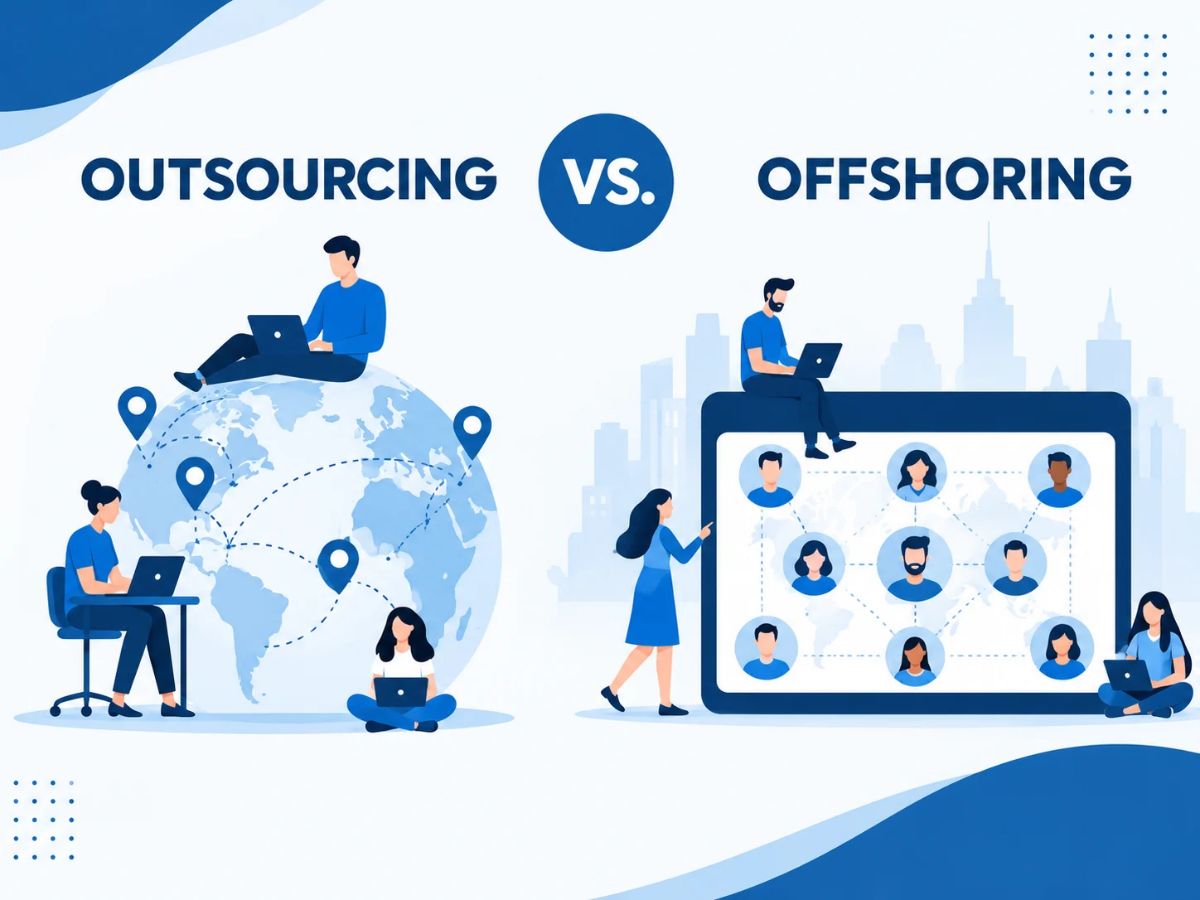
Outsourcing falls into two types of outsourcing categories: by operation (what you hand off, such as business process outsourcing services or project outsourcing) and by location (where the work happens: offshore, nearshore, onshore, or multisource).
Each outsourcing model balances cost, control, and access to specialized skills differently. Below, we break down the main models of outsourcing, the strategies behind them, and how to pick the one that fits your goals.
Outsourcing Types Organized by Operation
Operation-based models of outsourcing are defined by the function you hand to a third party. The right choice depends on your operational needs, budget, and the nature of the work.
Common examples include:
- Manufacturing outsourcing
- IT outsourcing (software development, cybersecurity, helpdesk)
- Knowledge process outsourcing (KPO) for analysis-heavy work like financial modeling
- Legal process outsourcing (LPO) for document review
- Recruitment process outsourcing (RPO) for hiring
Most companies run several of these at once. The two most widely used, BPO and project outsourcing, are covered below.
Business Process Outsourcing (BPO)
Business process outsourcing (BPO) transfers ongoing, repeatable functions such as payroll, accounting, HR, customer support, and call center operations to a specialized provider.
It began as a low-cost play tied to offshoring hubs like India, but mature BPO now adds process improvements, analytics, and AI-powered customer care tools.
Adoption is broad: a 2024 McKinsey report found 55% of companies already outsource part of their customer care (see the advantages of outsourcing customer service), and industry data shows about 84% of customer service organizations work with at least one BPO partner.
BPO services fit best when workflows are structured and need consistent quality tracking.
Project Outsourcing
Project outsourcing hands a one-off initiative to an external team with a defined scope, specific objectives, a set timeline, and a predetermined budget. Once the project is delivered, the engagement ends.
It’s usually priced under a fixed price agreement, which shifts delivery risk to the vendor and keeps budgets predictable.
Typical examples include app development, product prototyping, branding campaigns, tax preparation, and cybersecurity audits.
The benefit is speed and fresh expertise without hiring or pulling in-house staff off core work. The trade-off is that mid-project changes are hard, so you need detailed specifications upfront.
Outsourcing Types Organized by Location
Location-based models of outsourcing are defined by where your provider operates relative to you.
The main options are offshore, nearshore, onshore, and multisource outsourcing, with onsite outsourcing (external staff working inside your facility) as a less common variant.
Location drives cost, time zone overlap, cultural fit, and supply chain risk. It also shifts with policy: more than three-quarters of US manufacturers named trade uncertainty their top challenge in Q2 2025, per the National Association of Manufacturers, pushing many to rebalance work across offshore, nearshore, and onshore sites.
Offshore Outsourcing
Offshore outsourcing means contracting a provider in a distant country, usually one with lower labor costs such as India or the Philippines. It started with manufacturing and expanded into call centers and IT.
A common form in software is the offshore development center (ODC), a dedicated remote team that works only on your projects and acts as an extended office.
Benefits include cost savings, a vast talent pool, and round-the-clock development.
Downsides are:
- Time zone gaps
- Cultural and language barriers
- Longer onboarding
- Rising wages and tariffs that are shrinking the cost advantage in some regions
Nearshore Outsourcing
Nearshore outsourcing uses a provider in a nearby country, for example a US company working with teams in Mexico or Canada, or a Western European firm partnering with Eastern Europe.
It strikes a balance between offshore savings and onshore convenience: rates are lower than domestic ones, while overlapping time zones and cultural familiarity make real-time collaboration easier.
Nearshoring has gained momentum as rising labor costs and tariffs reduce China’s appeal as a manufacturing base. The US Chamber of Commerce notes many businesses now pair it with broader multisourcing strategies to manage risk.
Onshore Outsourcing
Onshore outsourcing means hiring a third-party provider within your own country, sometimes by reshoring work that was previously sent abroad.
It offers the easiest communication, no time zone friction, and simpler legal compliance, which suits sensitive or high-control work. Supporters also point to stronger supply chain resilience and domestic job creation.
The main drawbacks are higher costs and local skills shortages. In a Bain & Co. study, 80% of apparel brands said onshoring any part of their operations would be very difficult, showing that onshore is rarely the cheapest route.
Multisource Outsourcing
Multisource outsourcing spreads work across several providers, either for different functions or for parts of the same process.
For example, one vendor may handle software development, another cloud infrastructure, and a third cybersecurity. This gives you best-of-breed expertise and removes single points of failure, making it a practical risk management strategy.
It also covers geographic diversification: Bain & Co. found fashion and footwear brands cut their production spend in China from 43% to 33% in three years.
Many firms now run hybrid setups that blend offshore, nearshore, and onshore teams in one structure.
How to Choose the Right Outsourcing Model
To choose the right outsourcing model, start with what you should never outsource: your competitive differentiators. Then match the model to your needs:
- Clear, fixed scope suits project outsourcing on a fixed price.
- Evolving scope suits time and materials (T&M) or staff augmentation, which give you more control.
- Structured, high-volume processes fit BPO.
Weigh total cost, security and compliance, and time zone needs, and lock in KPIs through service level agreements (SLAs).
If results matter most, the top performance-based outsourcing models (incentive-based, shared risk-reward, and outcome-based contracts) tie provider pay to measurable outcomes.
FAQs
What are the two types of outsourcing?
Outsourcing is grouped by operation (the function outsourced, like BPO or IT) and by location (offshore, nearshore, onshore, or multisource).
What is an outsourcing model?
It’s the way you engage an external provider. It defines scope, pricing, responsibility, and governance. Examples include fixed price, time and materials, and staff augmentation.
Why do companies outsource?
Companies outsource to cut labor, infrastructure, and technology costs, to get specialized skills they don’t have in-house, and to free internal teams to focus on core business functions.