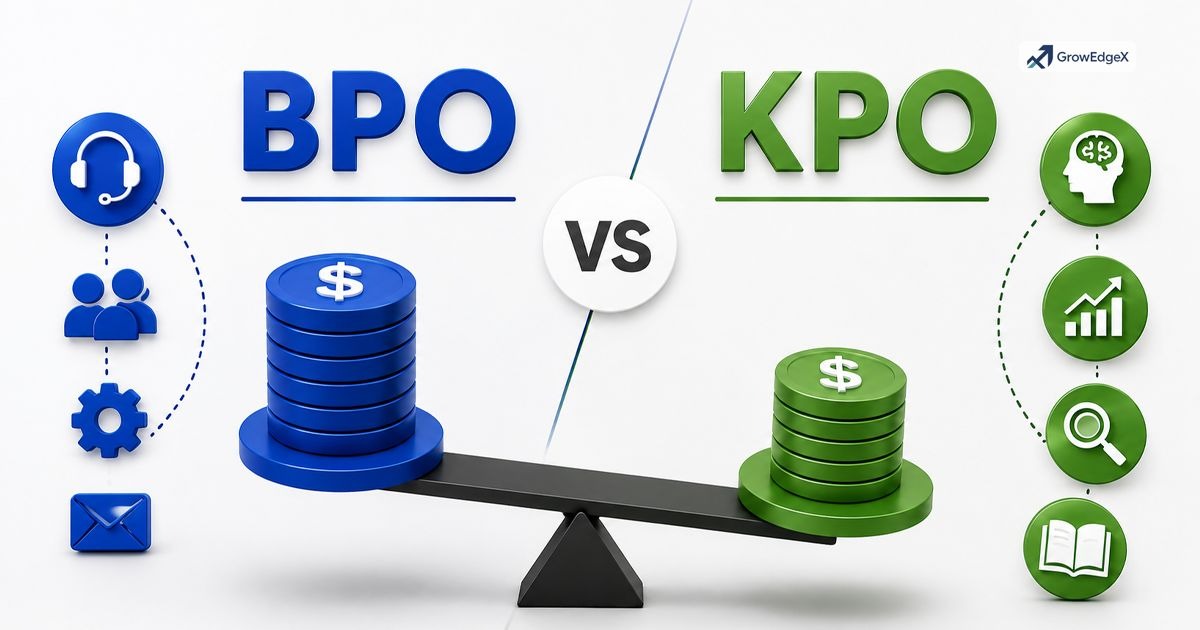
Every business owner hits a hard point. Work keeps adding up, your team has too much to handle, and most of the day gets used on tasks that don’t really grow your business. Sound familiar? That’s the exact problem business process outsourcing was made to solve.
Small businesses, law firms, healthcare providers, and startups across Plano, Texas, USA are outsourcing everything from payroll to customer support. As a result, they are scaling faster. In 2026, the global BPO market is worth $347.95 billion and rising rapidly. The real question is not whether you should outsource. It is why you have not started yet.
What Is Business Process Outsourcing (BPO)?
Here’s a question every growing business eventually asks: after all, Why are we spending half our time on tasks that aren’t actually our business? That question is exactly why business process outsourcing has become one of the fastest-growing industries on the planet. Simply put, what is BPO? It’s the practice of hiring an outside company to handle specific business functions for you.
Think about payroll. Think about customer support. Maybe IT. Or medical billing. Instead of building every department inside your company, you hand those tasks to specialists who only work on that one thing. You get expert work without the trouble of hiring.
By outsourcing business processes, companies spend less on operations and more on growth. Whether you’re a healthcare startup in Plano, TX, or an enterprise insurance firm in Dallas, the logic is the same: let experts handle what they are best at, so you can focus on what you are best at.
BPO Definition
BPO’s meaning in business is straightforward. You identify a business function and contract it to a third-party provider. That provider brings their own team, technology, and processes. You get the results without the extra cost.
It’s not just about saving money. It’s about working faster and getting expert help your team doesn’t have. Think of it like hiring an accountant instead of doing your own taxes. You get it done right, without learning the whole trade.
Discover More: BPO or KPO? See the real difference before you decide.
How Does BPO Work? A Step-by-Step Overview
How BPO works in practice follows a clear path. First, a business identifies which processes are non-core, meaning they’re necessary but not the reason clients pay you. Next, they find a BPO provider with proven expertise in those areas.
Then, both parties sign a contract that defines expectations, service level agreements (SLA), turnaround times, and performance metrics (KPI). The BPO provider takes over those functions using their own staff, software, and infrastructure.
Here’s a quick overview of the process:
| Step | What Happens |
| 1. Assessment | Business identifies non-core processes to outsource |
| 2. Research | The company evaluates the BPO companies’ list and checks references |
| 3. Contract | SLAs, KPIs, pricing, and compliance terms are agreed upon |
| 4. Onboarding | BPO provider learns your systems, workflows, and standards |
| 5. Execution | Provider handles the outsourced function daily |
| 6. Review | Regular reporting and performance checks keep quality high |
Key Takeaways Before You Dive In
Before we go further, here are three things every business owner should know.
- One, BPO is not just for big corporations. Around 37% of small businesses already outsource IT services and accounting.
- Two, the BPO industry overview covers far more than call centers.
- Three outsourcing trends for 2026 are pointing toward AI-powered, industry-specific, and cloud-based BPO models. If you’re not thinking about this now, your competitors already are.
Why Businesses in Dallas, TX, and Across the USA Choose BPO?
Dallas is booming. The DFW metroplex is home to thousands of fast-growing mid-market businesses. With that kind of growth comes a familiar problem: scaling operations fast without spending too much money.
That’s why BPO services have become a go-to strategy for businesses from Plano to Fort Worth. The cost of outsourcing services is almost always less than building equivalent in-house capacity. You skip the recruiting costs, training time, benefits packages, and office space entirely.
Why companies outsource today goes beyond just saving money. It’s really about growing fast when you need to, like scaling your team up during a busy season, then scaling back down without losing people. For businesses in competitive markets like Dallas, it’s about moving faster than everyone else.
The Strategic Benefits of BPO for Growing Companies
The benefits of BPO go beyond saving money. The right BPO partner already has skilled workers ready to go, so you don’t spend years finding and training them yourself. You also get better quality, since their team has handled this exact work many times before.
You benefit from cloud-based systems and automation tools that your team doesn’t have to build or maintain. And critically, you free your leadership team to think strategically instead of operationally.
Here’s what smart businesses in the USA are gaining from outsourcing right now:
Cost Reduction: Spend less on your internal team and processes
Speed: Experienced BPO teams can launch faster than internal hiring.
Expertise: Access specialists in HR, legal, finance, IT, and healthcare.
Scalability: Grow or shrink your outsourced team based on demand.
Technology: Tap into the BPO provider’s existing tech stack.
Focus: Redirect leadership energy toward core business growth strategy.
How Does BPO Help During Market Uncertainty and Economic Shifts?
Markets change. The economy goes up and down. Companies that hired too many full-time workers during past slowdowns paid a heavy price for it. With BPO, you lower that risk because your business doesn’t depend only on how many people you have on staff.
If revenue drops, you adjust your BPO contract. If revenue jumps, you grow your BPO team. Business continuity becomes far more manageable when your non-core operations have a dedicated external team that isn’t affected by your internal turbulence.
See the Full Guide: Outsource or hire? Break down BPO vs in-house here.
Back-Office vs. Front-Office BPO: What’s the Difference?

Not all outsourcing is the same. There are two broad categories, back-office and front-office, and understanding the difference helps you figure out what to outsource first.
Back-Office BPO Functions Explained
Back-office BPO handles the internal work that keeps a company running, but that customers never see directly. Think data entry, payroll processing, HR administration, accounting, compliance management, and document digitization.
These are tasks that are critical but deeply operational. For most businesses, they’re a drain on time and attention that could go toward revenue-generating activities.
Front-Office BPO Functions Explained
Front-office BPO deals with customer-facing interactions. Customer service, sales support, live chat, appointment scheduling, anything that touches the customer experience lives here.
Customer experience (CX) is one of the biggest drivers of front-office BPO growth right now. Businesses know that great CX wins customers and poor CX loses them. That’s why so many companies now outsource customer support to teams trained to deliver fast, reliable service every time.
Offshore, Onshore, and Nearshore BPO: Which Model Is Right for You?
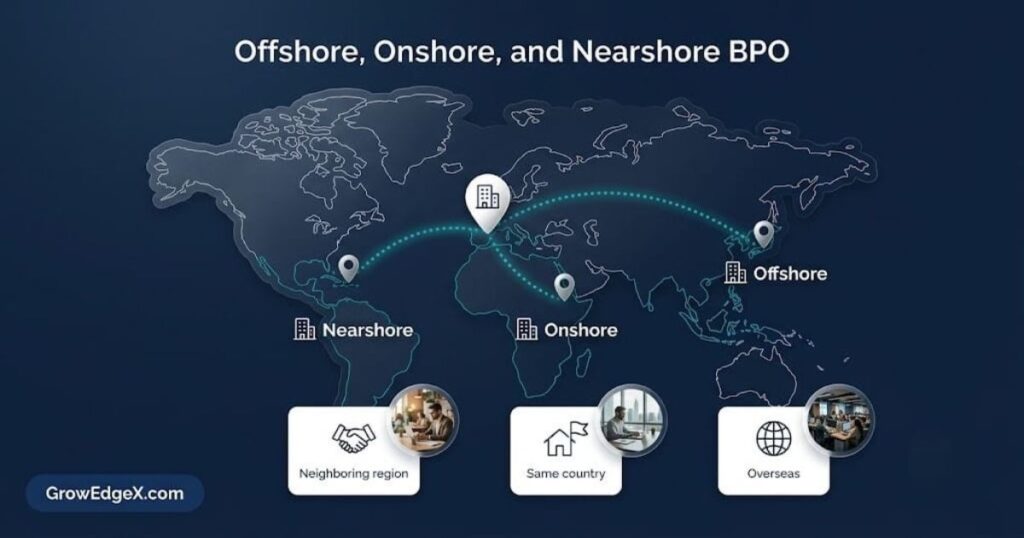
Onshore BPO Model: USA-Based Outsourcing
Onshore BPO means your outsourcing partner is also in the USA. Same time zone. Shared language. A common legal framework. For many businesses, especially in regulated industries like healthcare and legal, onshore is the only acceptable answer.
Communication is seamless, cultural alignment is natural, and compliance is straightforward.
Offshore BPO Services: Benefits and Risks
Offshore BPO moves functions to countries like Pakistan, the Philippines, or Eastern Europe. The primary appeal is cost reduction, since labor costs in these markets are significantly lower. Offshore BPO works well for high-volume, clearly defined processes like data entry, coding support, and customer service.
The risks include time zone gaps, communication challenges, and data security and compliance concerns that must be carefully managed through contracts and auditing.
Nearshore BPO: The Middle-Ground Approach
Nearshore BPO uses providers in neighboring countries for USA-based companies. The nearshoring trend is very strong in North America, with companies moving agile development to hubs in Latin America to align time zones.
You get significant cost savings without the communication friction of an offshore engagement.
Find More Helpful Tips: Before you decide, check the real pros and cons of outsourcing.
How Automation and AI Are Transforming Business Process Outsourcing?
Process automation and artificial intelligence are rewriting the rules of outsourcing business processes. Tasks that once required human input, like invoice matching and customer ticket routing, now run automatically.
Gartner reported in February 2026 that 91% of customer service and support leaders feel pressure from executive leadership to implement AI. BPO providers that can’t answer the AI question are already falling behind.
Agentic AI: The New Era of Autonomous Business Innovation
Agentic AI is the next frontier. Instead of following a fixed script, AI agents make decisions, take actions, and complete multi-step tasks autonomously. In BPO, this means an AI agent can handle an entire claims processing workflow without human intervention at each step.
The BPO industry in 2026 has changed from a simple support service into a real growth driver, with smart AI tools now helping companies move through today’s market faster and smarter than ever before.
Business Process Outsourcing Delivery Models and Pricing Structures
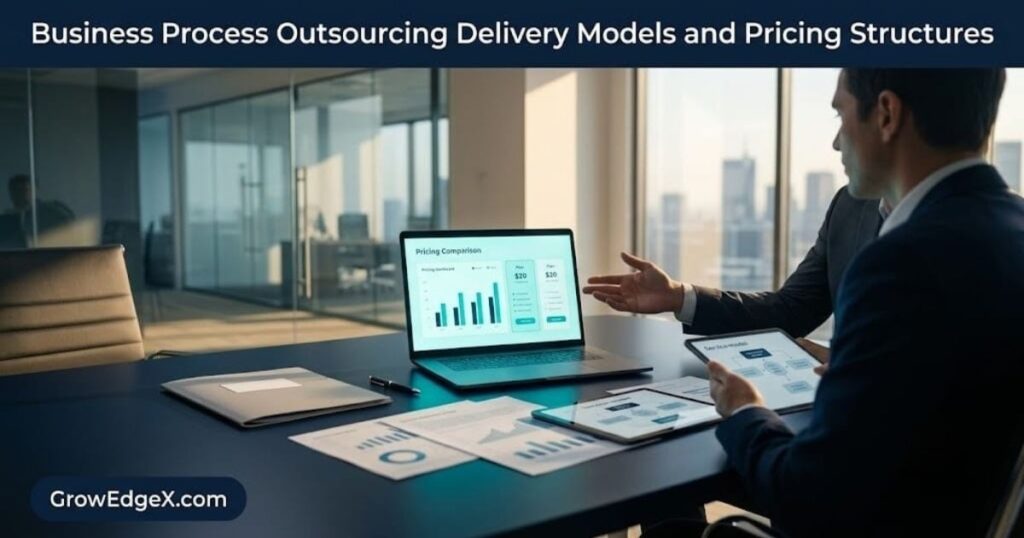
Hourly, Fixed Cost, Transaction-Based, and Hybrid Billing Models
The outsourcing investment varies by model. Here’s how the most common pricing structures work:
| Pricing Model | How It Works | Best For |
| Hourly | Pay per hour of work | Variable workloads |
| Fixed Cost | Monthly flat fee | Predictable, defined scope |
| Transaction-Based | Pay per unit processed | High-volume, standardized tasks |
| Outcome-Based | Pay for results | Sales, lead generation |
| Hybrid | Combination of models | Complex, mixed-function BPOs |
Benefits of BPO: Why It Works for Businesses of All Sizes
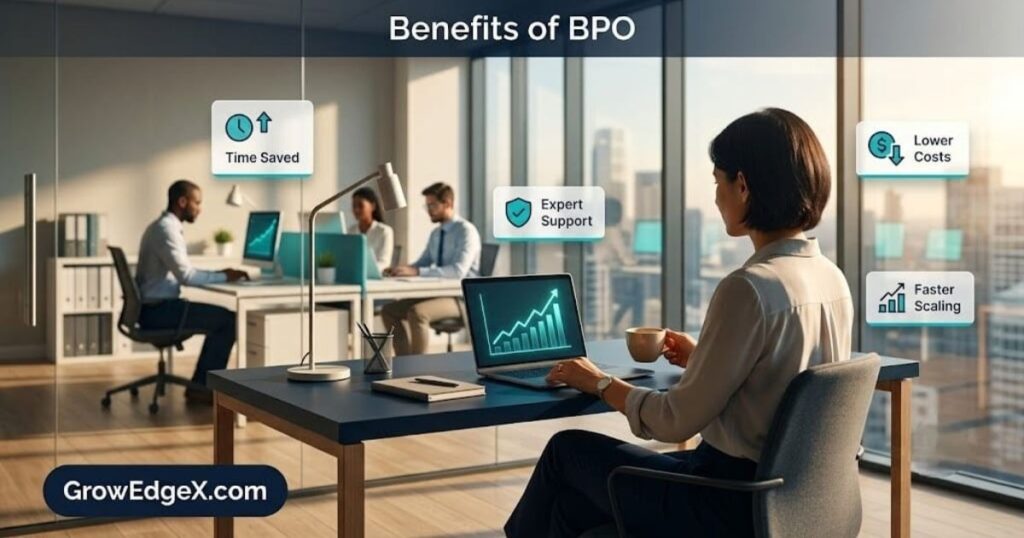
- Reduce operational costs by 20–40% with efficient BPO outsourcing solutions
- Improve business efficiency with dedicated, distraction-free BPO teams
- Access specialized talent instantly without full-time hiring costs
- Increase turnaround speed with pre-trained and process-ready teams
- Scale operations on demand with flexible BPO support
- Focus on core business functions while experts handle non-core tasks
Challenges and Risks of BPO You Should Know
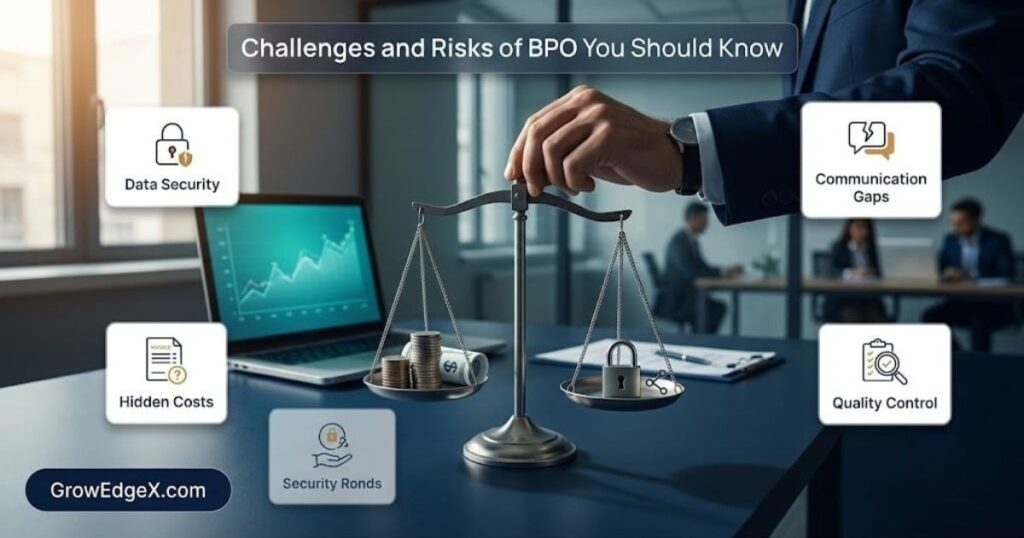
Disadvantages of BPO exist and deserve honest attention. Ignoring them doesn’t make them go away. Understanding them helps you manage them before they become problems.
- Loss of control over outsourced processes can impact performance and quality
- Communication barriers and time zone differences can delay operations
- Cultural differences may create misunderstandings without clear workflows
- Data security and compliance risks when handling sensitive information
- Poor vendor selection can lead to long-term operational issues
- Lack of proper monitoring can reduce BPO service quality over time
How to Choose the Right BPO Partner for Your Business
Choosing a BPO company is one of the most important decisions you’ll make for your operations. Here’s a clear framework that actually works.
Assess Your Internal Strengths and Outsourcing Needs
Start by mapping your current operations. Which functions are core to your competitive advantage? Those stay in-house. Which functions are necessary but do not differentiate? Those are your outsourcing candidates.
Resource allocation becomes clearer once you have this map.
Check Reputation, Certifications, and Industry Expertise
Don’t skip due diligence. Ask for client references. Verify certifications like ISO, SOC 2, and HIPAA, whatever is relevant for your industry.
Look for examples of outsourcing success in companies similar to yours.
Evaluate the scalability and Flexibility of the BPO Provider
A great BPO partner grows with you. Can they scale from 5 agents to 50 when you need it? Can they add new service lines as your business evolves?
Business scalability needs to be built into the BPO relationship from day one.
Set KPIs and Monitor BPO Performance Consistently
Performance metrics (KPI) are your primary management tool once you’ve outsourced. Define them clearly before the engagement starts. Common BPO KPIs include first call resolution rate, average handle time, error rate, processing turnaround time, and customer satisfaction scores.
Review them regularly, at a minimum.
Ensure Data Security Standards and Compliance Protocols
Data security and compliance deserves its own checklist. Ask every potential BPO partner these questions: How do you protect client data? What’s your breach notification protocol? Who has access to our records?
Their answers will tell you everything.
GrowEdgeX – Your Trusted Business Process Outsourcing Partner in Plano, TX
BPO Services We Deliver for Healthcare, Legal, Staffing & More in the DFW Area
GrowEdgeX is a Plano, TX-based BPO partner built for businesses across the Dallas-Fort Worth market and the USA. Their team covers healthcare BPO, legal intake, accounting and bookkeeping, IT and workflow automation, and BPO services like lead generation and customer support. GrowEdgeX delivers expert outsourcing with genuine local understanding.
What sets GrowEdgeX apart isn’t just the service catalog. It’s the combination of local market knowledge, industry-specific expertise, and a commitment to quality assurance processes that keeps your operations running to the highest standards. Every engagement starts with a thorough assessment of your needs, clearly defined service level agreements (SLA), and performance metrics (KPI) that keep both teams fully accountable.
From Plano to Nationwide: How GrowEdgeX Scales With You
GrowEdgeX serves businesses in Plano, Dallas, Fort Worth, and the broader DFW area, but its capabilities extend nationwide. As your business grows from a regional operation to a national enterprise, GrowEdgeX scales alongside you.
Their enterprise solutions infrastructure means you’re never outgrowing your BPO partner. Whether you’re processing 100 transactions a day or 100,000, GrowEdgeX has the team, technology, and systems to handle it. Ready to find out how GrowEdgeX can reduce your operational costs and accelerate your growth? Contact the team today for a free consultation.
FAQ’s
What Are the Different Types of BPO?
Types of BPO include HR outsourcing, Finance and Accounting BPO, customer service BPO, healthcare BPO, legal BPO, IT outsourcing, manufacturing BPO, logistics BPO, marketing BPO, KPO, and back-office BPO. Each covers a distinct category of business functions.
What Is a BPO Call Center?
A BPO call center is an outsourced customer service operation that handles inbound and outbound phone interactions on behalf of your company. They’re trained on your products, policies, and brand voice to represent you directly to customers.
How Is BPO Different from a Call Center?
BPO vs call center: A call center handles phone calls only, while a contact center manages all communication channels, including phone, email, live chat, SMS, and social media. Most modern BPO customer service operations are full-contact centers.
What Is BPO in Simple Words for an Interview?
BPO (Business Process Outsourcing) is when a company outsources non-core tasks to an external service provider to improve efficiency and reduce operational costs. It allows businesses to focus on their main goals while experts handle routine work.
What Is Customer Service in the BPO Industry?
What is customer service in the BPO industry? It’s the management of all customer interactions, including support, complaints, billing questions, returns, and onboarding by a third-party BPO provider trained to represent your brand.
Can a Small Business Use BPO Services?
Absolutely. BPO services for small businesses are widely available and often modular. You outsource just what you need. Around 37% of small businesses already outsource IT services and accounting, and the number keeps growing every year.
What Is the BPO Model for Healthcare Businesses?
Healthcare BPO covers medical billing, claims processing, coding, patient coordination, appointment scheduling, and HIPAA compliance management. It’s handled by teams specifically trained in healthcare regulations and payer requirements.
How Does Automation Improve BPO Services?
Process automation and RPA allow BPO providers to handle high-volume, repetitive tasks faster and more accurately than manual processing. This drives down costs, speeds up turnaround, and improves operational efficiency across the board.
The Bottom Line: BPO Is More Than Cost-Cutting – It’s a Growth Strategy
Here’s the truth about business process outsourcing that too many companies miss: it was never really about cutting costs, not at its core. The real story is about business growth strategy, about freeing your best people to do their best work while experts handle everything else.
The U.S. BPO market is set to grow steadily as the global market rises from $347.95 billion to $906.27 billion by 2035. That kind of growth doesn’t happen because companies are looking for cheap labor. It happens because outsourcing genuinely makes businesses stronger, faster, and more resilient.
Outsourcing trends for 2026 point toward smarter, more specialized, tech-driven BPO. Businesses now want partners who know their industry, not just general support.
The businesses building the future aren’t doing it alone. They’re doing it with the right BPO partner. Whether you’re a healthcare provider in Plano, a law firm in Dallas, or a startup trying to grow without breaking the bank, one thing is clear: business process outsourcing in 2026 isn’t just an option. It’s the smartest way to grow.
Interested in exploring BPO services for your business in Dallas, TX, or across the USA? GrowEdgeX offers free consultations for businesses ready to scale smarter. Reach out today.